Material Bridging in Silos: Risks and Improving Flow Monitoring
Rettar explains how material bridging, ratholing and wall buildup disrupt silo discharge, and how the 3DPro2300 radar scanner maps the whole material surface to reveal uneven buildup that single-point level sensors can miss.
Unexpected material blockages can interrupt production and increase operating costs in bulk material handling facilities. In silo and hopper applications, reliable discharge depends on the material flowing consistently toward the outlet. However, changes in moisture, particle size, and material properties can cause powders and bulk solids to stick together or build up along the vessel walls.
Over time, this can lead to material bridging, ratholing, or restricted discharge. For plants aiming to improve process reliability, silo monitoring plays an important role. By combining continuous level measurement with 3D surface monitoring, operators can gain a better understanding of material conditions inside storage vessels.
Understanding Material Bridging and Wall Buildup
Bulk materials such as wet coal, cement, and fine grain products can become cohesive under certain storage conditions. Moisture, particle size, temperature, and material composition all influence how freely they flow.
During filling and discharge, some materials may stick to hopper walls or accumulate around the outlet. As buildup develops, it can form a stable arch across the discharge opening. This is known as material bridging. In other cases, material may continue to discharge through a narrow channel while the surrounding material remains stationary. This condition is called ratholing.
Both conditions can disrupt material flow. A silo may also appear to contain sufficient material even when the outlet is partially blocked or the material is not moving as expected.
Manual attempts to clear blockages, including hammering or uncontrolled vibration, can damage equipment and create additional safety concerns. In facilities handling combustible dust, maintenance and cleanout activities may also require careful dust hazard controls.
Single-Point Radar vs. 3D Radar: What Can Each Measure?
Non-contact radar level transmitters are widely used in silos and hoppers. They provide distance or level readings without contacting the stored material. Depending on the application, different radar frequencies can offer different beam characteristics and installation options.
Lower-frequency radar is used in many conventional level measurement applications. Its beam angle is generally wider than that of higher-frequency radar devices, so antenna selection and installation position are important, particularly in vessels with internal structures.
Higher-frequency radar typically provides a narrower beam and can be useful in vessels with limited installation space or narrow nozzles. It measures the distance to the material surface along a defined measurement path.
Radar with an even higher frequency can provide an even narrower beam, depending on the antenna design. It may be suitable for applications with restricted installation openings or where a focused measurement path is required. Actual performance depends on the sensor design and process conditions.
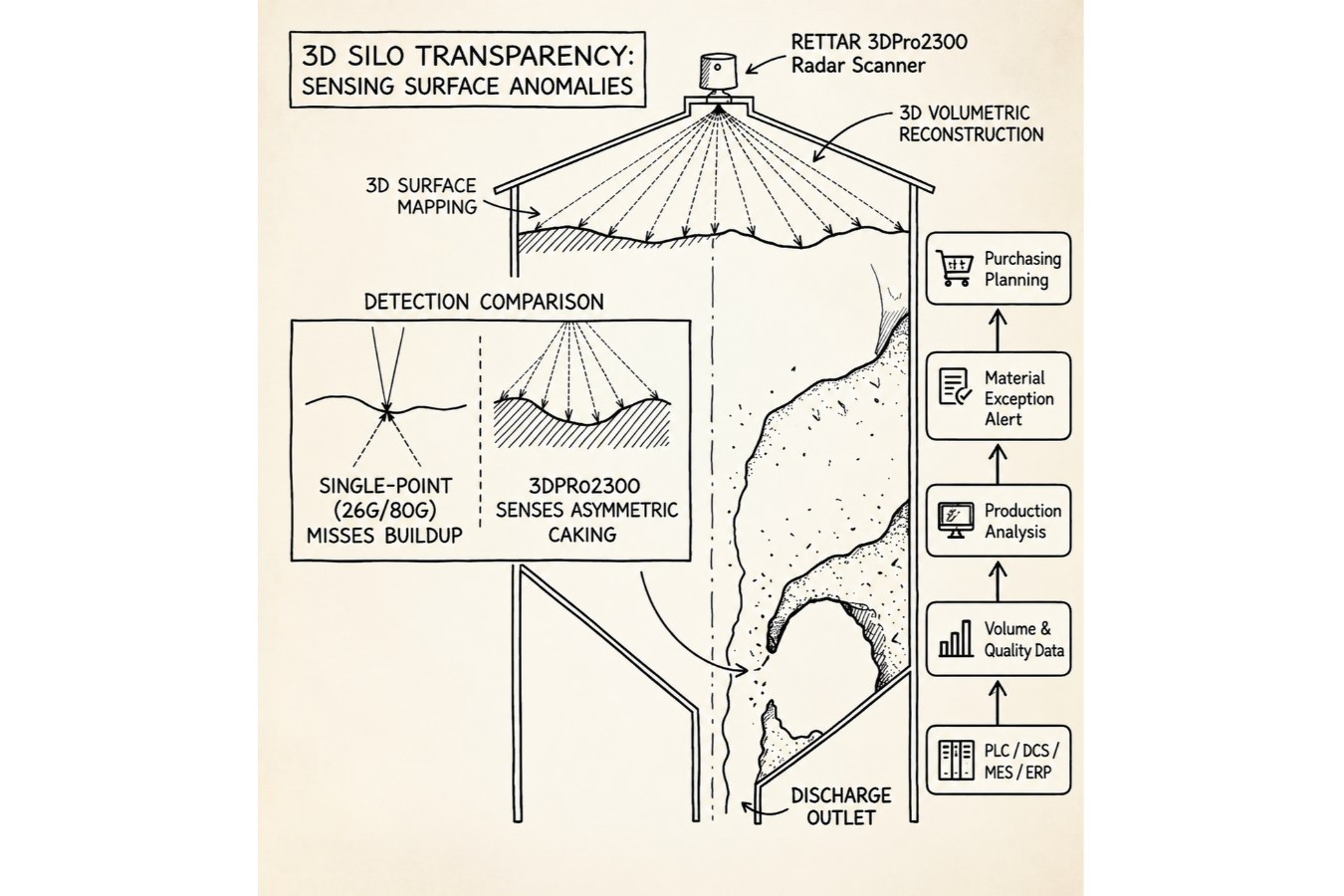
Although single-point radar transmitters provide useful level information, each device measures only a limited area of the material surface. A reading from one location may not show uneven buildup near the silo wall, an off-centre material pile, or the formation of a rathole elsewhere in the vessel.
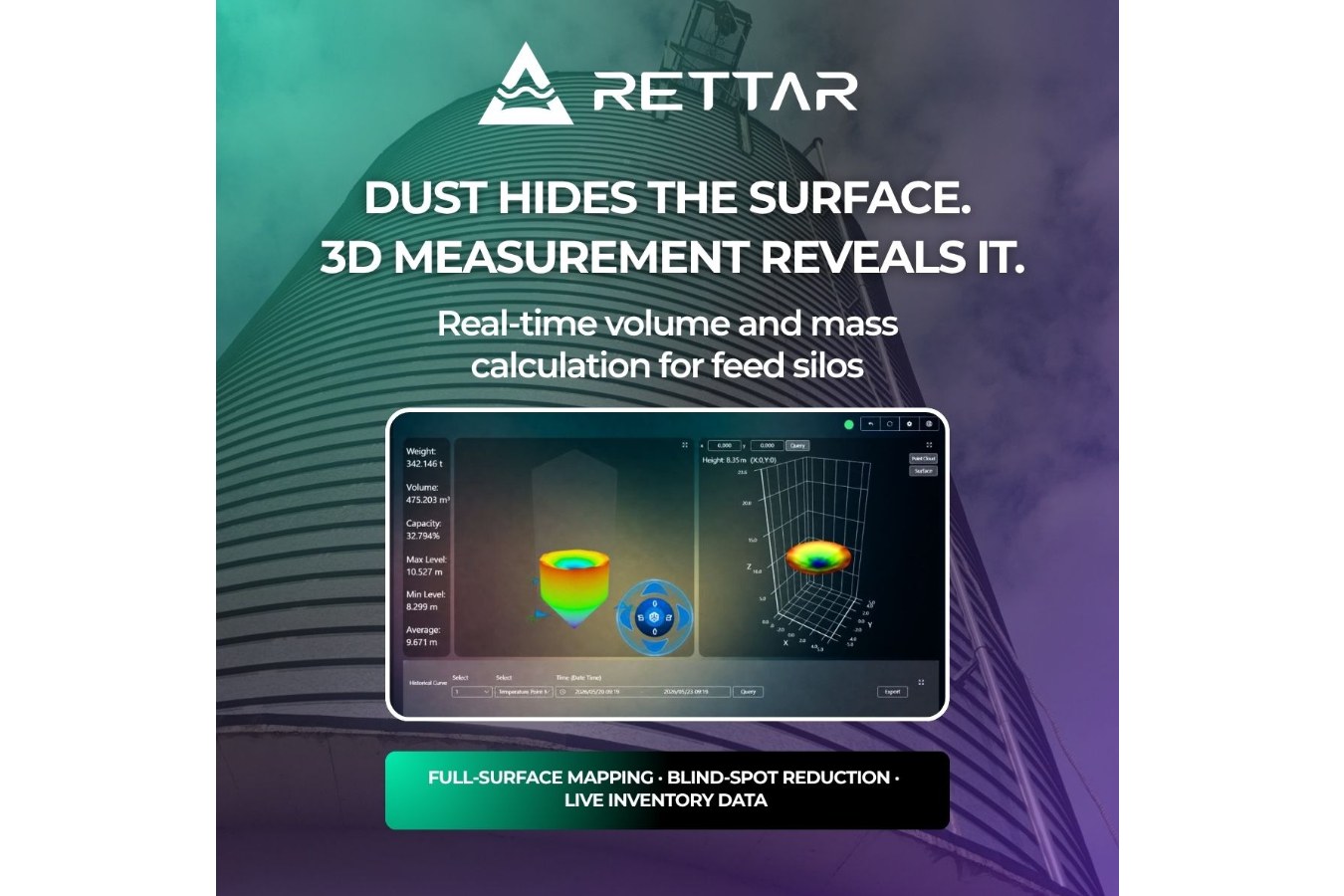
This is where 3D radar scanning offers a different approach. Rather than measuring distance along one line, the Rettar 3DPro2300 Radar Scanner collects multiple measurement points across its scanning field. These points are used to reconstruct the material surface as a 3D model.
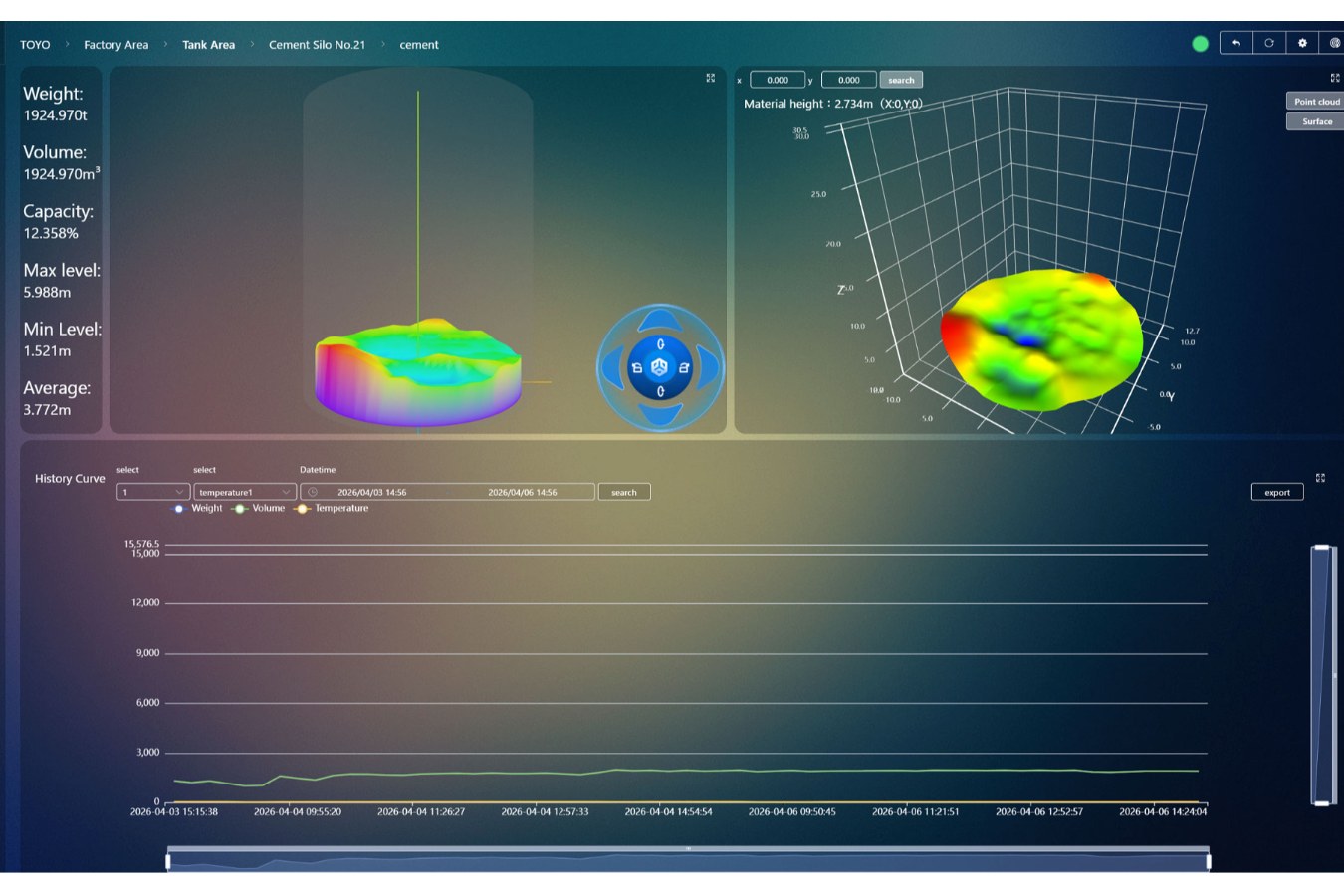
The resulting 3D surface mapping provides a broader view of material distribution. It can help operators identify uneven surfaces, changes in pile shape, and potential areas of material buildup that may not be visible through a single-point reading. This additional information supports 3D volumetric measurement and more informed silo inventory monitoring.
Monitoring Material Conditions to Support Silo Safety
Material buildup does not only affect discharge performance. Uneven material distribution can also create non-uniform loads within a storage vessel. Depending on the silo design and material conditions, these loads may place additional stress on walls, supports, and hopper structures.
A 3D representation of the material surface helps operators understand how material is distributed inside the vessel. By tracking changes over time, they can identify unusual surface patterns and investigate potential buildup before it develops further.
However, surface scanning alone cannot confirm the presence or internal stability of every material bridge. It should be used alongside appropriate process monitoring, inspection procedures, and established silo safety practices.
With more comprehensive surface information, maintenance teams can make better-informed decisions about when further inspection or cleaning may be needed. This can also help reduce reliance on routine manual checks in difficult-to-access locations.
Connecting Silo Measurement Data to Plant Operations
Reliable silo management involves more than knowing the material level at one point. Operators also need useful information about material distribution, estimated volume, and changes in storage conditions.
3D radar scanners convert surface measurements into digital models and inventory data. Depending on the system configuration, this information can be made available to plant control systems and management platforms. Integration with PLC, MES, or ERP systems can help connect silo measurement data with production planning, inventory management, and procurement workflows. It also gives relevant teams a more consistent source of information for operational decisions.
By combining 3D silo measurement with existing plant systems, facilities can improve material visibility and support more informed inventory control.
Explore 3D Silo Measurement Solutions
Every silo has different material and installation conditions. Explore Rettar's Silo Measurement Systems to see how 3D radar scanning can support material monitoring and inventory management in your facility.