Supplier sign in
Home
STAY INFORMED
Subscribe to our monthly newsletter.
Your email address will never be disclosed to any third party.
Read our privacy notice.
Product news
13-10-2026  |  153 x
Share:

Na22 Density Meter: Tackling Difficult Slurry Measurement

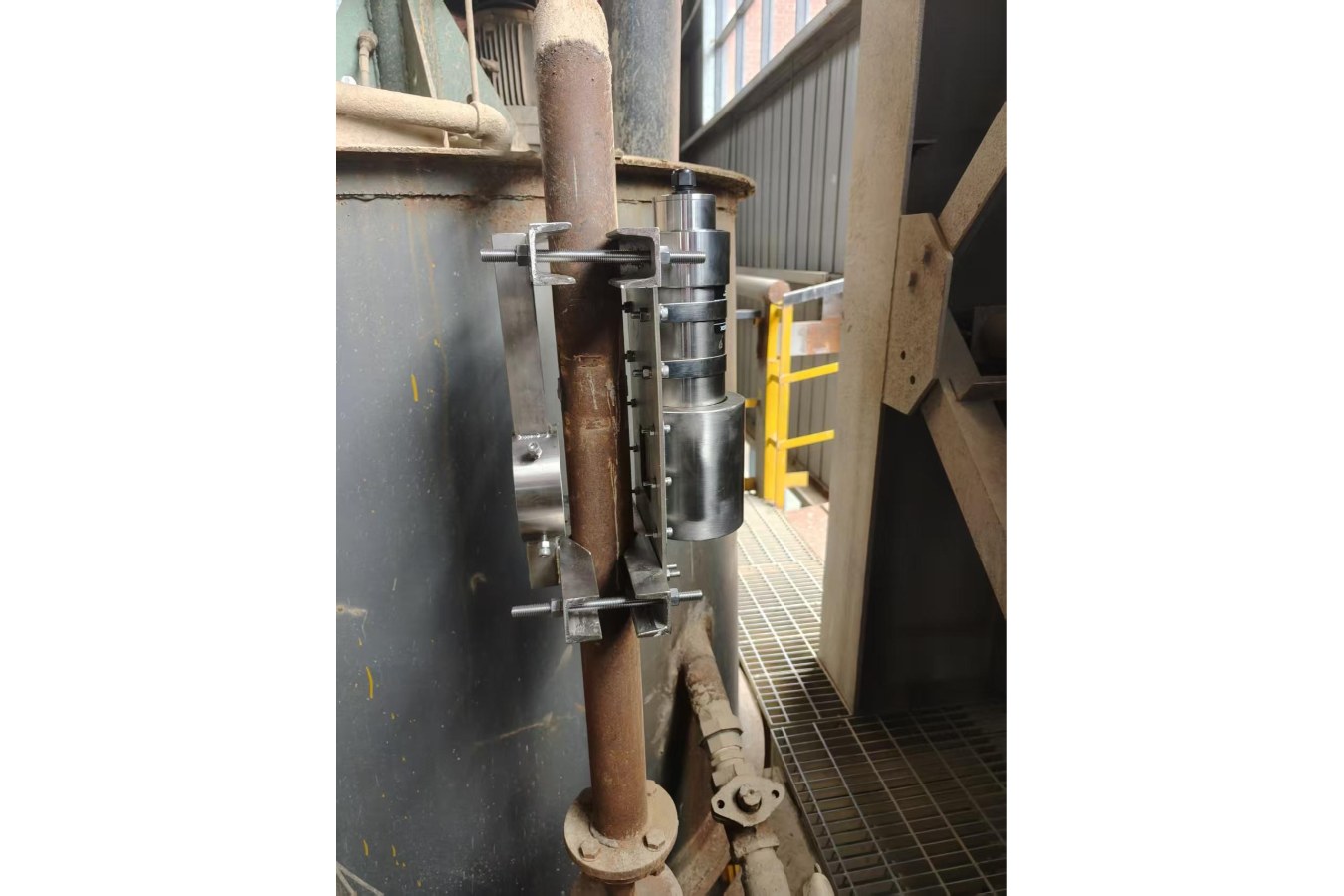
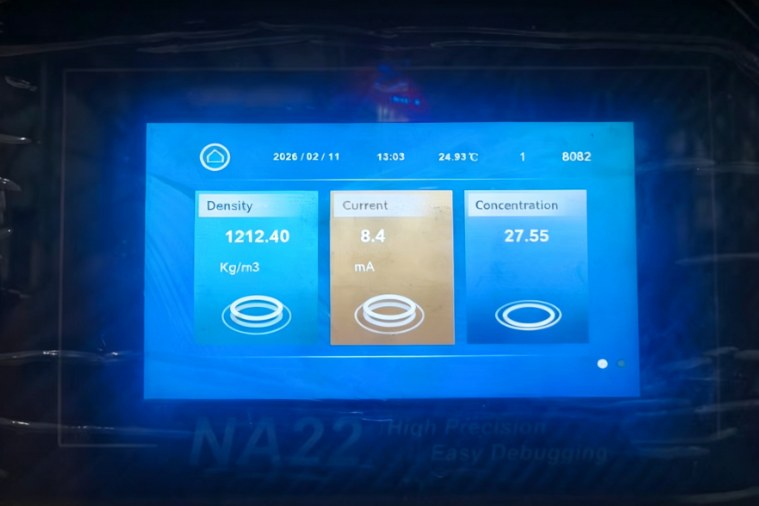
Rettar's Na22 Density Meter measures abrasive, high-viscosity tungsten slurry in a vertical pipeline without contact: clamp-on mounting, energy spectrum detection, accuracy of ≤ ±1% and an exemption-level source below 1,000 kBq.
Reliable slurry density measurement is essential for process monitoring in mining and mineral processing. However, highly abrasive materials, high viscosity, and challenging pipeline configurations can make stable, representative measurements difficult to achieve.

In this tungsten ore processing application, the material was fine slime—a high-viscosity slurry containing extremely fine, abrasive particles—flowing vertically downward through a pipeline. These conditions demanded a measurement solution that could address material wear, flow-related uncertainty, and operational safety without disrupting the production process.

The Na22 Density Meter combines non-contact clamp-on installation, advanced energy spectrum detection, and an exemption-level gamma radiation source to address these application requirements.

High-Viscosity, Abrasive Tungsten Slurry

Avoiding Wear and Clogging
Tungsten ore fine slime presents significant challenges for conventional wetted sensors. Continuous contact with abrasive particles can accelerate component wear, while viscous material may accumulate around sensing elements and increase the risk of clogging, depending on the sensor design.

These issues can lead to more frequent maintenance, additional production interruptions, and higher operating costs. For plant engineers, the challenge is not simply measuring density, but maintaining a practical measurement arrangement in demanding process conditions.

The Na22 Density Meter addresses this challenge through non-contact, clamp-on installation. Mounted on the outside of the pipeline, it measures without direct exposure to the abrasive slurry.
This approach offers three practical benefits:
  • Reduced abrasive exposure: Measurement components remain outside the slurry, avoiding direct contact with abrasive tungsten particles.
  • Simplified installation: The clamp-on configuration requires no pipe cutting for installation.
  • Less intrusive maintenance: No in-line sensing element is introduced into the process stream, helping reduce maintenance associated with wetted components.
By eliminating direct sensor contact with the material, the Na22 helps address wear-related concerns while supporting production continuity.

The Flow Challenge: Vertical Downward Movement

Factors Affecting Slurry Density Measurement
The second challenge was the pipeline orientation: the slurry was flowing vertically downward.
Although gravity assists bulk flow in this configuration, actual material distribution depends on viscosity, flow velocity, solids concentration, and particle characteristics. Local flow disturbances and entrained gas, where present, can further complicate measurement conditions.

For high-viscosity slurry, these factors make it important to select an appropriate measurement location and ensure that the resulting data represent the process material reliably.

Radiometric Density Measurement Technology

The Na22 Density Meter uses highly sensitive NaI/synthetic crystal detectors and advanced energy spectrum detection technology to support radiometric density measurement.

Energy spectrum detection helps distinguish the measurement signal from background radiation interference, supporting more reliable signal interpretation. This capability is particularly relevant when engineers need consistent density information in challenging industrial environments.

The Na22 has a specified measurement accuracy of ≤ ±1%, subject to applicable measurement conditions and installation requirements.

While no instrument can eliminate every uncertainty caused by changing flow conditions, sensitive detection and background interference discrimination help address signal-related challenges. Correct installation and application-specific commissioning remain essential to achieving representative results.

Addressing Mining-Site Safety and Regulatory Requirements

Density monitoring must also fit the site's safety procedures and regulatory framework. Traditional radiometric instruments can introduce additional considerations involving radiation-source management, approvals, and operating procedures.

The Na22 Density Meter uses an exemption-level gamma radiation source with an activity below 1,000 kBq. Its low source activity is intended to reduce radiation-related management and regulatory burdens.
Actual exemption status depends on local regulations, source classification, and site requirements. The relevant authorities or radiation-safety team should confirm applicable obligations before installation.
This approach allows engineers to consider measurement performance alongside operational practicality and radiation-safety requirements.

Need Help with Slurry Density Measurement?

Every mineral processing application has different material properties, flow conditions, and installation requirements. Contact Rettar technical team to discuss your slurry density measurement challenges and evaluate whether the Na22 Density Meter is suitable for your process.


Company information

More items

Fix Silo Inventory Blind Spots with Real-Time 3D Mapping Conveyor scales and point sensors create false bulk solids inventory in silos. Rettar's 3D radar maps the full material surface for precise volume.
Fix Silo Inventory Blind Spots with Real-Time 3D Mapping
Conveyor scales and point sensors create false bulk solids inventory in silos. Rettar's 3D radar maps the full material surface for precise volume. The Inventory Illusion: Why Scale Calculations Leave You Blind Relying purely on conveyor belt scales to track silo stock creates a dangerous tracking illusion. On paper, your numbers balance. In reality, two major issues are constantly throwing off your inventory: * Scale Drift & Belt Tension: Moisture, material buildup on rollers, and mechanical belt stretch create small hourly errors. Over a week, these "tiny" errors snowball into massive accounting variances. * Unseen Surface Topography: Scales can’t see what’s happening inside the silo. Material rarely stacks in a perfect, symmetrical cone. Single-point radar sensors don't help much either—they only measure distance to a single spot on a complex, uneven pile, leaving massive volumetric blind spots. The Bottom Line: When you manage inventory by calculating mass flow instead of measuring the actual physical heap inside, you're managing blindly. Operations are often forced to take massive quarterly write-offs…
08-10-2026  |  318  |  product news  | 
Continue reading
3D Radar Volume Inventory: Penetrating Dust for 24/7 Mining Operations Rettar's 80GHz 3D mmWave radar sees through coal dust and steam and measures true volume in silos, sheds and stockyards 24/7, without manual surveys or single-point errors.
3D Radar Volume Inventory: Penetrating Dust for 24/7 Mining Operations
Rettar's 80GHz 3D mmWave radar sees through coal dust and steam and measures true volume in silos, sheds and stockyards 24/7, without manual surveys or single-point errors. Real-Time Bulk Inventory Challenges in Heavy Mining & Coal Operations Maintaining accurate bulk material inventory across coal sheds, blending yards, and storage silos is a critical challenge for modern mining operations. Plant managers depend on precise real-time volume and tonnage metrics to control coal blending ratios, optimize plant throughput, and satisfy accounting audit requirements. However, acquiring reliable real-time inventory data in high-dust environments remains difficult: * Manual Surveying Risks: Traditional survey methods using manual laser rangefinders or drones require halting material handling. They put personnel into dangerous, confined high-dust zones and only yield delayed, non-continuous static reports. * Optical & LiDAR Limitations: Optical LiDAR scanners installed overhead frequently fail in mining applications. Suspended coal dust, iron ore fines, and ambient steam quickly coat optical lenses, causing severe measurement drift or total system…
24-09-2026  |  342  |  product news  | 
Continue reading
Rettar Named Finalist for 2026 Australian Bulk Handling Awards Rettar's 3DPro2300 Radar Scanner was shortlisted for safety excellence in bulk handling. It enables real-time 3D inventory tracking in silos, reducing manual risks.
Rettar Named Finalist for 2026 Australian Bulk Handling Awards
Rettar's 3DPro2300 Radar Scanner was shortlisted for safety excellence in bulk handling. It enables real-time 3D inventory tracking in silos, reducing manual risks. A significant milestone in Rettar’s global expansion, recognizing our commitment to Safety Excellence in Bulk Handling. Organized by Bulk Handling Review, the Australian Bulk Handling Awards is a professional industry awards platform dedicated specifically to the bulk solids handling sector. It recognizes outstanding achievements in technology innovation, safety improvement, automation, reliability, and sustainable development, with applications spanning mining and minerals, grain and agriculture, cement and building materials, energy and power, ports and terminals, and bulk material handling. Shortlisted in Safety Excellence: Standing Out Among Industry Finalists For Rettar, being selected as a finalist is more than an industry distinction. It represents professional recognition of the practical value of Rettar’s 3DPro2300 Radar Scanner technology in addressing real-world safety and operational challenges in bulk material handling. In the 2026 Safety Excellence…
21-09-2026  |  403  |  press release  | 
Continue reading
3D Volumetric Mapping From Level Measurement to Inventory Transparency Rettar's 3DPro2300 radar scanner maps the full 3D surface of bulk solids in silos, with up to 16,200 points per scan, ±2 mm accuracy and continuous operation in heavy dust.
3D Volumetric Mapping From Level Measurement to Inventory Transparency
Rettar's 3DPro2300 radar scanner maps the full 3D surface of bulk solids in silos, with up to 16,200 points per scan, ±2 mm accuracy and continuous operation in heavy dust. The Inventory Blind Spot In bulk solid storage across process industries, inventory tracking remains a persistent operational blind spot. When bulk materials enter a storage silo, they do not settle into a predictable, flat liquid surface. The formation of variable angles of repose, surface peaks and valleys, asymmetric piling, rat-holing, and material adhesion to silo sidewalls creates a highly complex topography. While traditional inventory tracking methods such as mass extrapolation and single-point measurement are widely utilized and foundational to many operations, relying on them exclusively for complex bulk solids may introduce certain uncertainties. For instance, calculating inventory solely based on inbound and outbound flow can occasionally lead to cumulative variances between recorded and physical stock over time due to natural material compaction or moisture changes. Similarly, single-point level sensors provide reliable, localized distance metrics. However,…
17-09-2026  |  373  |  product news  | 
Continue reading
ATEX/IECEx Certified 3D Radar Scanner for High-Dust Silo Inventory Rettar has introduced the 3DPro2300 radar scanner for bulk solids inventory management in high-dust silos. The ATEX/IECEx certified system uses 80GHz FMCW radar to provide real-time 3D surface mapping.
ATEX/IECEx Certified 3D Radar Scanner for High-Dust Silo Inventory
Rettar has introduced the 3DPro2300 radar scanner for bulk solids inventory management in high-dust silos. The ATEX/IECEx certified system uses 80GHz FMCW radar to provide real-time 3D surface mapping. The Inventory Blind Spot: Why Mass Extrapolation & Single-Point Leveling Fail For decades, mine operators and bulk material handling facilities have relied on mass extrapolation via belt scales or single-point level measurement to estimate inventory. However, calculating theoretical weight or measuring a single vertical distance does not constitute true inventory management. Bulk solids behave unpredictably. Heavy dust generated during crushing, loading, and feeding operations, coupled with variable moisture and material discharge dynamics, frequently complicates the environment inside silos, making it difficult to calculate the volume of materials accurately. When management relies on legacy measurement paradigms, they operate with a critical operational blind spot: * Mass Extrapolation (Belt Scales): Relies on input/output throughput formulas. Cumulative measurement errors compound rapidly over time and fail to account for material compaction or structural hang-ups,…
11-09-2026  |  488  |  product news  | 
Continue reading
PORTALS
✓ BulkSolids-Portal Schuettgut-Portal Recycling-Portal
Related
Bulkgids.nl
SIGN UP FOR OUR NEWSLETTER
Newsletter archive
Service and contact
About, ContactDisclaimerPrivacyAdvertisingControl panel login
Follow us
Linked
Supplier sign in