Supplier sign in
Home
STAY INFORMED
Subscribe to our monthly newsletter.
Your email address will never be disclosed to any third party.
Read our privacy notice.
Product news
24-09-2026  |  70 x
Share:

3D Radar Volume Inventory: Penetrating Dust for 24/7 Mining Operations

80GHz 3D mmWave radar solves real-time bulk solids inventory challenges in dusty mining environments. It penetrates dust for accurate volume in silos and stockyards.

Real-Time Bulk Inventory Challenges in Heavy Mining & Coal Operations

Maintaining accurate bulk material inventory across coal sheds, blending yards, and storage silos is a critical challenge for modern mining operations. Plant managers depend on precise real-time volume and tonnage metrics to control coal blending ratios, optimize plant throughput, and satisfy accounting audit requirements.

However, acquiring reliable real-time inventory data in high-dust environments remains difficult:
  • Manual Surveying Risks: Traditional survey methods using manual laser rangefinders or drones require halting material handling. They put personnel into dangerous, confined high-dust zones and only yield delayed, non-continuous static reports.
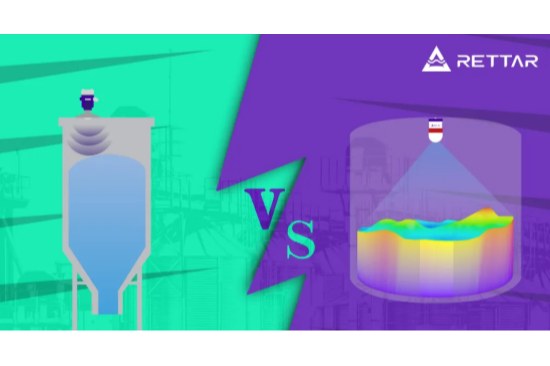
  • Optical & LiDAR Limitations: Optical LiDAR scanners installed overhead frequently fail in mining applications. Suspended coal dust, iron ore fines, and ambient steam quickly coat optical lenses, causing severe measurement drift or total system blinding.
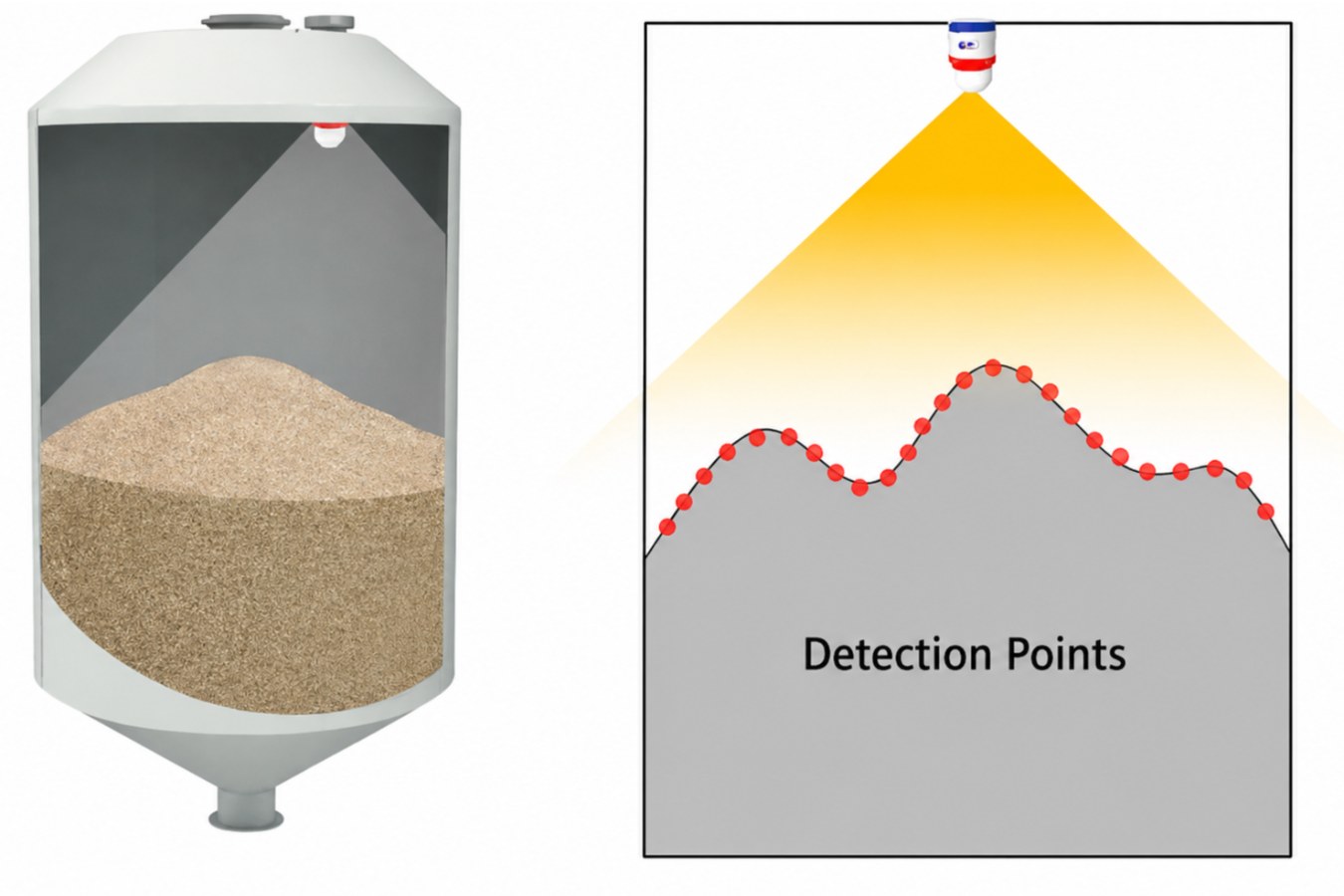
  • Single-Point Radar Errors: Conventional radar or ultrasonic level transmitters only measure a single point directly beneath the gauge. Because bulk solids stack unevenly—forming conical peaks, drawdown funnels, and wall rat-holing—extrapolating total volume from a single distance value can cause inventory errors exceeding 20% to 30%.

80GHz 3D Millimeter-Wave Radar: Built for High Dust Environments

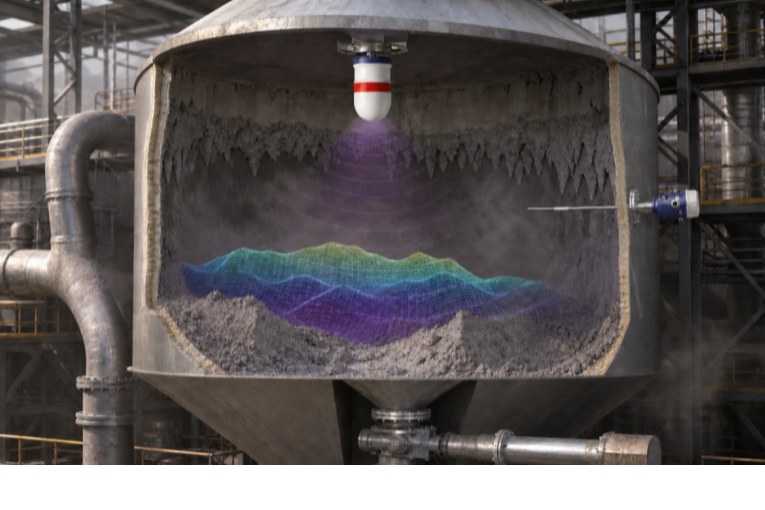
To solve dust-blindness, non-contact 80GHz millimeter-wave (mmWave) 3D radar scanning technology provides a continuous, 24/7 inventory monitoring solution. Operating in the high-frequency radar spectrum, millimeter-wave signals feature physical wavelengths that pass directly through heavy airborne coal dust, particulate clouds, and steam without signal attenuation or reflection interference.

Key engineering advantages for industrial mining include:

  • Dust & Steam Penetration: Signal propagation remains unaffected by flying dust particles or atmospheric turbulence, eliminating the need for optical lens wiping or constant air purging.
  • ATEX & IECEx Explosion-Proof Certification: Fully certified for hazardous dust and gas environments (Zone 20, 21, and 22), making the radar safe for volatile coal storage silos, covered domes, and underground surge pockets.
  • Zero-Maintenance Industrial Design: Non-contact measurement with no internal moving parts eliminates mechanical wear, dramatically reducing Long-Term Total Cost of Ownership (TCO).

Field Application: Multi-Radar 3D Point Cloud Stitching for Stockyards & Silos
Storage Sheds & Blending Yards
In large enclosed storage sheds and automated blending yards—handling iron ore, copper concentrate, bauxite, or coal—a single scanner cannot cover the entire footprint due to structural shadows and long site dimensions.

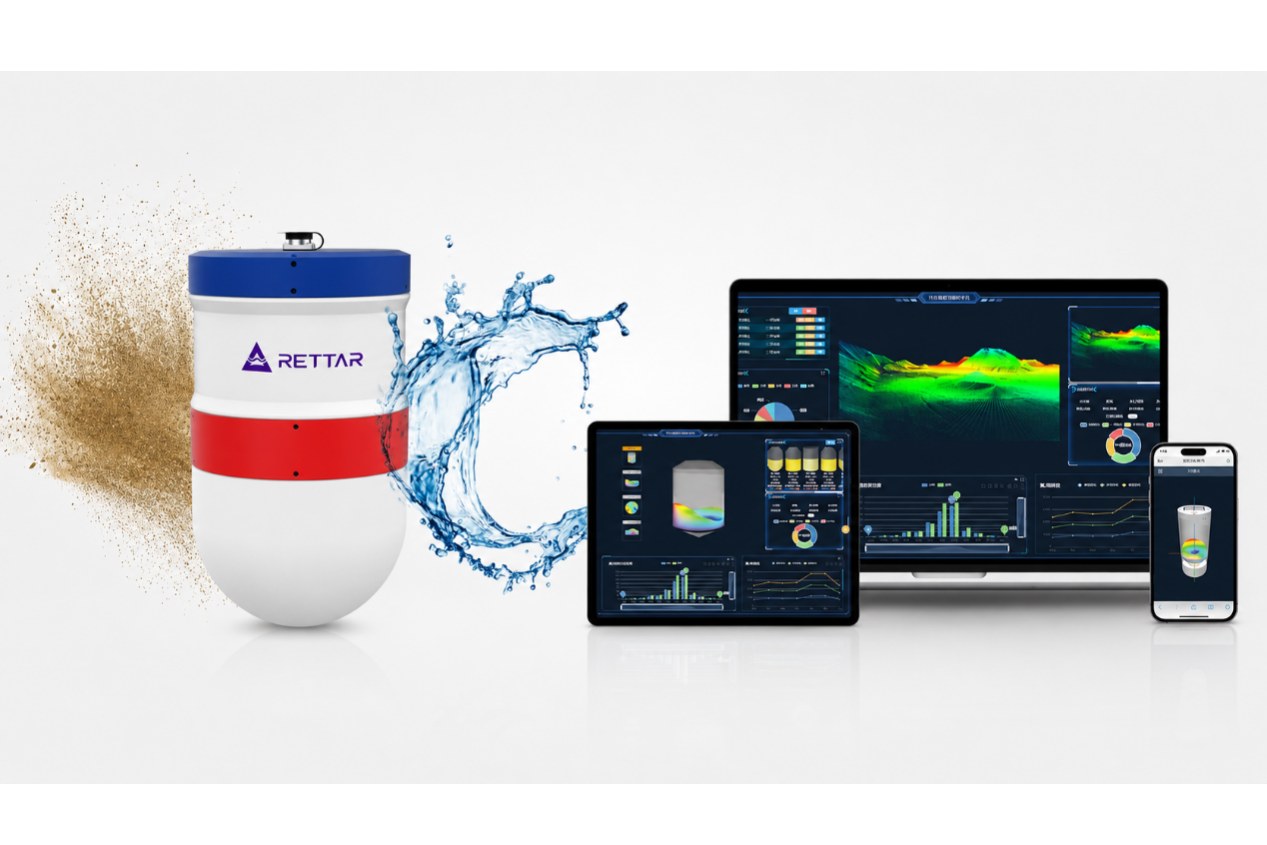
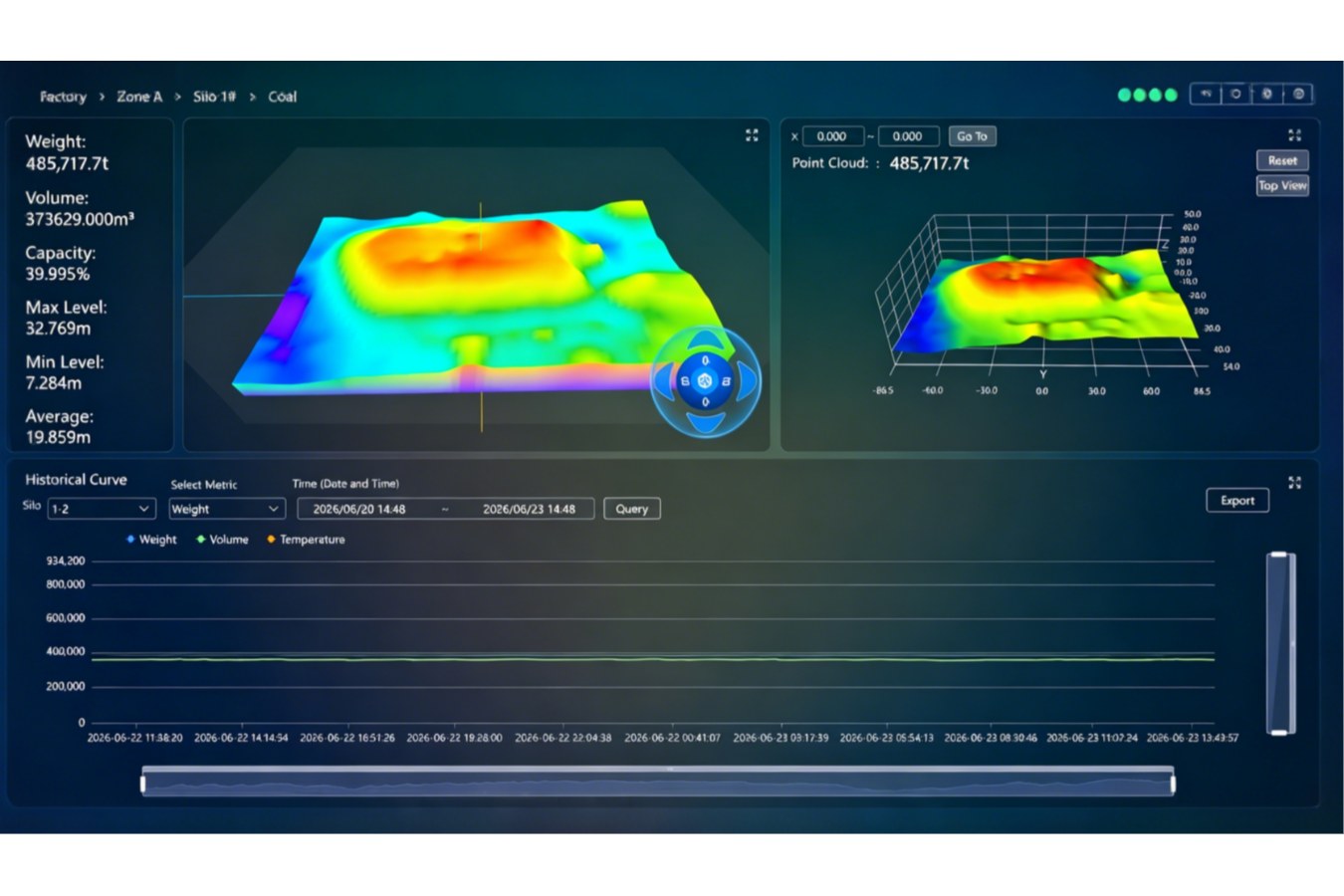
To achieve full coverage, an array of 3D mmWave radar scanners is installed overhead along the roof trusses. An automated 3D point-cloud stitching algorithm merges live data streams from all radar units in real time, building a continuous 3D surface mesh of the entire yard. Operators get accurate zone-by-zone volume calculations, live material blending profile maps, and early detection of dead inventory pockets directly in their control room.

High-Dust Vertical Storage Silos & Surge Bins

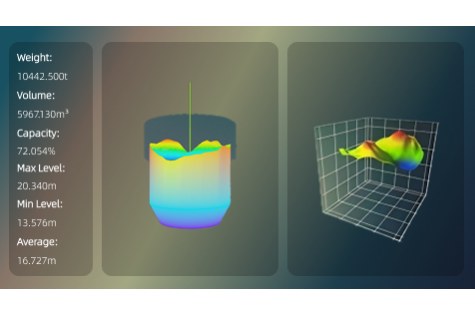
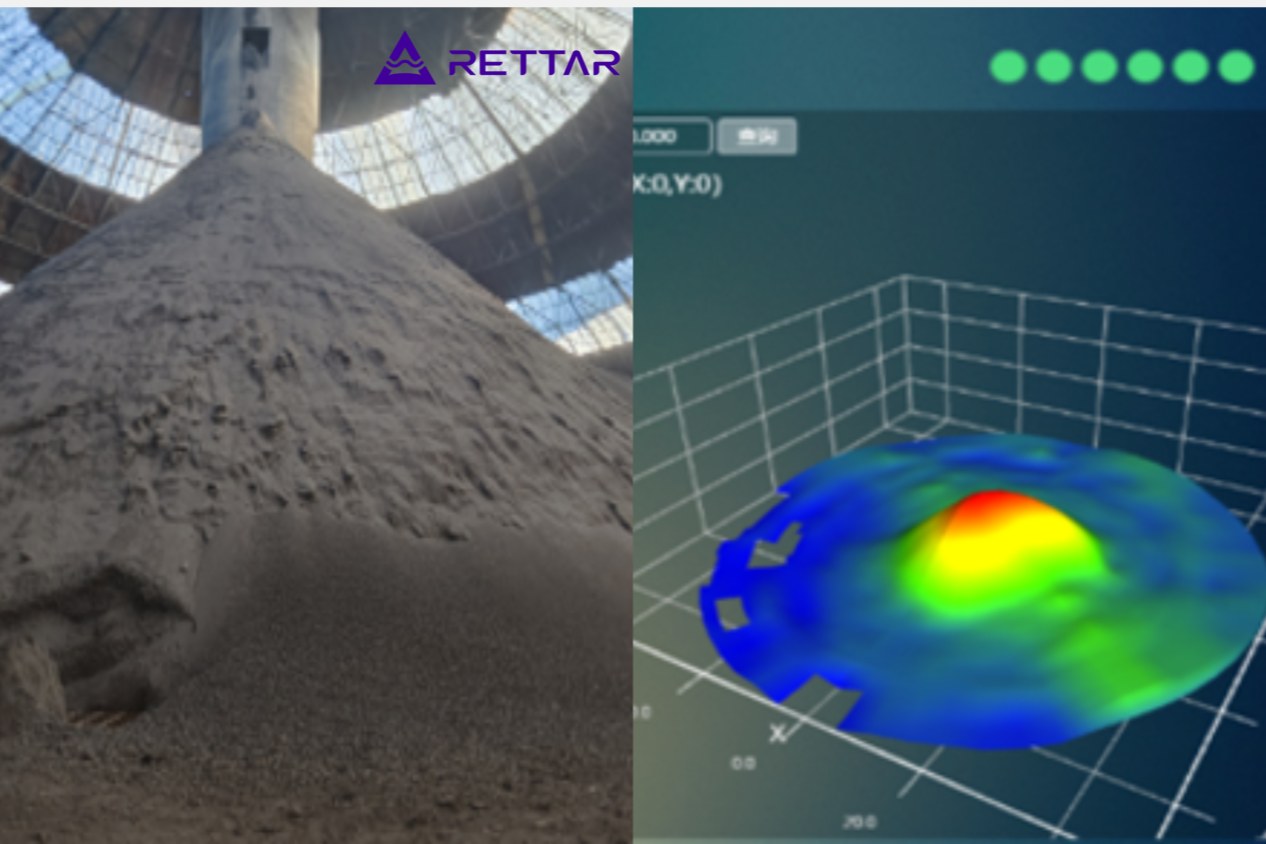
In vertical storage silos and surge bins carrying crushed run-of-mine (ROM) ore, fine concentrates, or coal, 3D radar units continuously sweep the material surface to capture asymmetrical drawdown craters and surface topographies under heavy loading dust.

By calculating true net volumetric inventory in real time, the system provides precise tonnage data straight into enterprise SCADA, MES, or ERP platforms—delivering actionable insights to optimize production scheduling, ensure accurate off-take and shipment planning, and streamline daily mass balance reconciliation.

Downstream Process Sensing: Slurry Density & Silo Level Limits

Beyond 3D bulk volume inventory, comprehensive digital plant control requires rugged sensing across mineral processing lines:
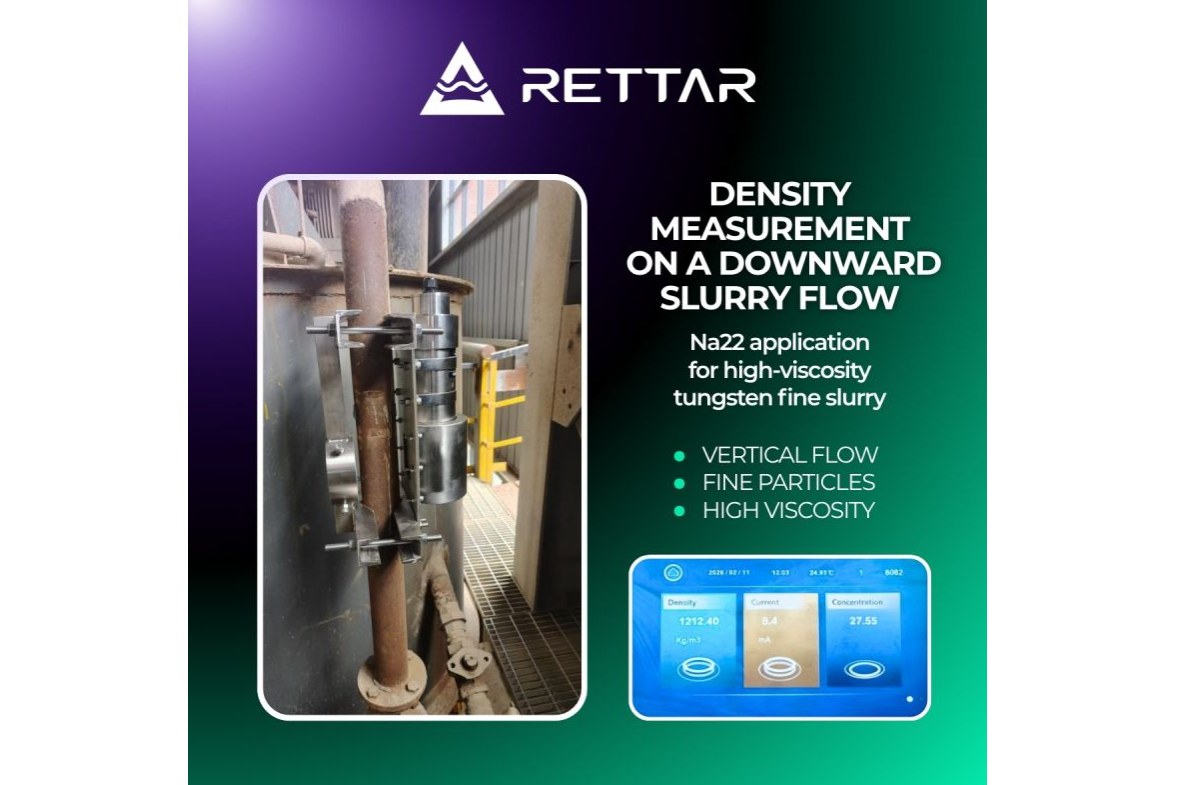
  • Non-Invasive Slurry Density Measurement: In flotation circuits, grinding loops, and tailings management, continuous slurry density tracking is vital for chemical dosing and mass balance. Non-invasive density sensors measure directly through pipeline walls without radioactive sources, avoiding strict radiation regulatory burdens while maintaining continuous operational uptime.

Silo & Tank Level Limit Switches

For high-level overfill prevention and low-level limit interlocking across both solid storage (silos, hoppers, crushers, and chutes) and liquid/slurry tanks (storage vessels, sumps, and flotation cells), heavy-duty point level switches provide essential fallback protection. Built to withstand severe vibration, chemical corrosion, and abrasive impact, they deliver instant interlock triggering to prevent catastrophic spills and pump dry-running.

Integrating multi-radar 3D point cloud stitching with non-invasive process sensors allows mining and coal facilities to transition from reactive estimations to automated digital control. By deploying ATEX/IECEx certified 3D millimeter-wave radar scanners, mining operations eliminate hazardous manual surveys, maintain true 24/7 inventory accuracy under heavy dust, and protect downstream processing machinery.


Company information

More items

Rettar Named Finalist for 2026 Australian Bulk Handling Awards Rettar
Rettar Named Finalist for 2026 Australian Bulk Handling Awards
Rettar's 3DPro2300 Radar Scanner was shortlisted for safety excellence in bulk handling. It enables real-time 3D inventory tracking in silos, reducing manual risks. A significant milestone in Rettar’s global expansion, recognizing our commitment to Safety Excellence in Bulk Handling. Organized by Bulk Handling Review, the Australian Bulk Handling Awards is a professional industry awards platform dedicated specifically to the bulk solids handling sector. It recognizes outstanding achievements in technology innovation, safety improvement, automation, reliability, and sustainable development, with applications spanning mining and minerals, grain and agriculture, cement and building materials, energy and power, ports and terminals, and bulk material handling. Shortlisted in Safety Excellence: Standing Out Among Industry Finalists For Rettar, being selected as a finalist is more than an industry distinction. It represents professional recognition of the practical value of Rettar’s 3DPro2300 Radar Scanner technology in addressing real-world safety and operational challenges in bulk material handling. In the 2026 Safety Excellence…
21-09-2026  |  162  |  press release  | 
Continue reading
3D Volumetric Mapping From Level Measurement to Inventory Transparency Rettar
3D Volumetric Mapping From Level Measurement to Inventory Transparency
Rettar's 3DPro2300 radar scanner maps the full 3D surface of bulk solids in silos, with up to 16,200 points per scan, ±2 mm accuracy and continuous operation in heavy dust. The Inventory Blind Spot In bulk solid storage across process industries, inventory tracking remains a persistent operational blind spot. When bulk materials enter a storage silo, they do not settle into a predictable, flat liquid surface. The formation of variable angles of repose, surface peaks and valleys, asymmetric piling, rat-holing, and material adhesion to silo sidewalls creates a highly complex topography. While traditional inventory tracking methods such as mass extrapolation and single-point measurement are widely utilized and foundational to many operations, relying on them exclusively for complex bulk solids may introduce certain uncertainties. For instance, calculating inventory solely based on inbound and outbound flow can occasionally lead to cumulative variances between recorded and physical stock over time due to natural material compaction or moisture changes. Similarly, single-point level sensors provide reliable, localized distance metrics. However,…
17-09-2026  |  178  |  product news  | 
Continue reading
ATEX/IECEx Certified 3D Radar Scanner for High-Dust Silo Inventory Rettar has introduced the 3DPro2300 radar scanner for bulk solids inventory management in high-dust silos. The ATEX/IECEx certified system uses 80GHz FMCW radar to provide real-time 3D surface mapping.
ATEX/IECEx Certified 3D Radar Scanner for High-Dust Silo Inventory
Rettar has introduced the 3DPro2300 radar scanner for bulk solids inventory management in high-dust silos. The ATEX/IECEx certified system uses 80GHz FMCW radar to provide real-time 3D surface mapping. The Inventory Blind Spot: Why Mass Extrapolation & Single-Point Leveling Fail For decades, mine operators and bulk material handling facilities have relied on mass extrapolation via belt scales or single-point level measurement to estimate inventory. However, calculating theoretical weight or measuring a single vertical distance does not constitute true inventory management. Bulk solids behave unpredictably. Heavy dust generated during crushing, loading, and feeding operations, coupled with variable moisture and material discharge dynamics, frequently complicates the environment inside silos, making it difficult to calculate the volume of materials accurately. When management relies on legacy measurement paradigms, they operate with a critical operational blind spot: * Mass Extrapolation (Belt Scales): Relies on input/output throughput formulas. Cumulative measurement errors compound rapidly over time and fail to account for material compaction or structural hang-ups,…
11-09-2026  |  271  |  product news  | 
Continue reading
Waste-to-Energy Plant Monitoring: 3D Radar & Sensing Solutions WtE plants manage diverse bulk materials. Radar scanners, level sensors, and point switches optimize inventory in pits, hoppers, and silos.
Waste-to-Energy Plant Monitoring: 3D Radar & Sensing Solutions
WtE plants manage diverse bulk materials. Radar scanners, level sensors, and point switches optimize inventory in pits, hoppers, and silos. Waste-to-energy (WtE) plants handle a variety of materials, including incoming waste, combustion residues, flue gas treatment reagents, and leachate. These materials can create different measurement challenges, such as dust, fog, high humidity, material buildup, corrosion, and irregular material surfaces. For this reason, WtE plants often require different monitoring technologies for different process areas. 3D radar scanning, radar level measurement, laser scanning, and point-level switches can be selected according to the material, operating conditions, and monitoring requirements. Monitoring Challenges Across Waste-to-Energy Plants Waste Storage Pits Waste storage pits contain mixed and irregular materials that are constantly changing. Moisture, fog, dust, and odors can also make visual inspection difficult. A 3DPro2300 Radar Scanner can scan the material surface and generate a three-dimensional model, providing information about material height, surface distribution,…
04-09-2026  |  315  |  product news  | 
Continue reading
Summer Silo Audits: Beat Dust Risks with 80GHz 3D Radar Sensing Summer heat makes bulk solids cling to silo walls and distorts inventory figures. Rettar measures the surface without contact using the 80 GHz 3DPro2300 radar scanner, 16,200 points per sweep, ATEX and IECEx certified.
Summer Silo Audits: Beat Dust Risks with 80GHz 3D Radar Sensing
Summer heat makes bulk solids cling to silo walls and distorts inventory figures. Rettar measures the surface without contact using the 80 GHz 3DPro2300 radar scanner, 16,200 points per sweep, ATEX and IECEx certified. Rising seasonal temperatures introduce serious operational challenges across bulk material handling facilities. In agricultural grain silos and industrial coal storage, intense ambient heat combined with fine airborne dust elevates thermal buildup and static explosion risks. Passing strict summer safety audits requires accurate, continuous monitoring without exposing operators to hazardous conditions. Implementing an 80GHz 3DPro2300 Radar Scanner for coal silos and grain processing provides a 3D surface mapping solution that eliminates static risks while ensuring precise bulk inventory tracking. Unseen Hazards Under Extreme Summer Heat Hot summer days change how bulk materials behave inside storage silos. Direct sun bakes steel silo roofs, trapping heat and moisture inside closed spaces. In these conditions, dry grain, starch, and coal dust stick to smooth silo walls. This material clinging forms hidden bridges, holes, and thick crusts that nobody can see from the outside.…
27-08-2026  |  516  |  product news  | 
Continue reading
PORTALS
✓ BulkSolids-Portal Schuettgut-Portal Recycling-Portal
Related
Bulkgids.nl
SIGN UP FOR OUR NEWSLETTER
Newsletter archive
Service and contact
About, ContactDisclaimerPrivacyAdvertisingControl panel login
Follow us
Linked
Supplier sign in