Supplier sign in
Home
STAY INFORMED
Subscribe to our monthly newsletter.
Your email address will never be disclosed to any third party.
Read our privacy notice.
Specialist article
05-03-2021  |  3231 x
Share:

Handling Bulk Materials; What’s the Big Deal?

Process technologies have advanced enormously the past decades. But flow problems have persisted. This article will discuss some of the more common causes. by R.J. Farnish
The movement and storage of bulk materials within processes has been a fundamental activity for many plants since the event of the industrial revolution in the 18th century. Process technologies have advanced enormously in their sophistication and efficiency over the intervening period to the current day. If it were possible to bring an engineer from the early days of industrialisation to see what is available today they almost certainly would not believe their eyes at the sheer diversity of plant equipment tailored for specific process requirements and end products. Sadly, what they probably would be able to relate to are the silos, bunkers and hoppers that function poorly and are often on the receiving end of the not so tender attentions of plant operators.

This article will discuss some of the more common causes of processing/flow problems that have persisted over the decades.

Fundamentals

The discharge problems that are experienced when handling bulk materials that may exhibit less favourable flow characteristics can range from irregular discharge through to complete flow interruptions (which may be either intermittent or stable until intervention takes place).

Flow stoppages

Discharge interruptions are frequently found in hoppers and silos, and can take the following forms:
  • Mechanical arching – involving the physical interlocking of relatively coarse particles (not a very common issue and typically associated with aggregate or extreme shape materials such as municipal waste),
  • Cohesive arching - cohesion between fine particles
  • “Rat holing” - emptying of the central flow channel developed in a core flow vessel, whereby the bulk of the inventory has sufficient internal strength that it can support itself - resulting in the formation of a empty flow channel extending from the top surface down to the outlet.

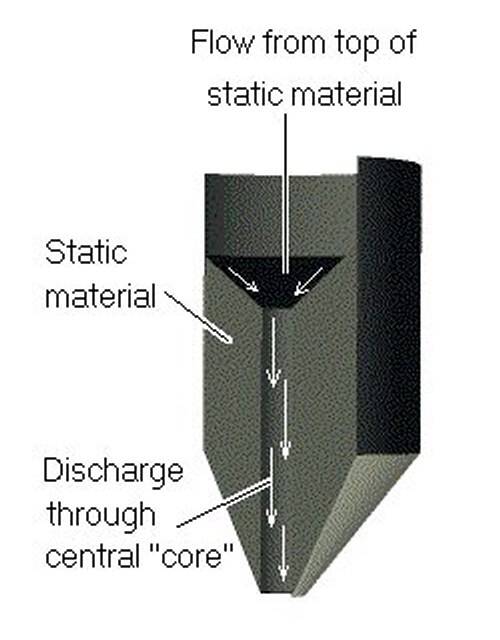
These flow problems are frequently found in hoppers and silos that have been designed without the reference to measured flow properties or equipment types inherited from older plant and pressed into service. In both instances the need to design equipment suitable for the flow characteristics of the powder to be handled will not have been addressed, and recourse to the installation of vibrators or air injection will be the usual approach adopted to initiate or maintain flow. It should be recognised that unless flow measurements are taken and the information incorporated into a design for a bunker or silo, that the default flow pattern that will develop will invariably be core flow (Fig 1), in which case the bunker/silo will operate on a first in, last out mode of material discharge. This flow behaviour will be typified by erratic flow rates which are also sensitive to the head of material in the storage scheme.

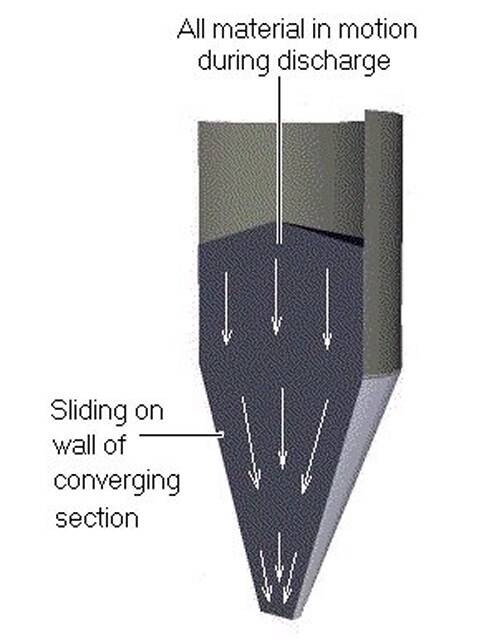
The two main discharge behaviours that can develop in silos and hoppers are as shown in the figures 1 & 2 below, which illustrate these flow patterns in the context of conical silos, but the principles are equally applicable to rectangular or pyramidal forms of storage vessels.

Core flow

Fig 1, illustrates a discharge behaviour generally referred to as core flow (but also sometimes referenced as funnel flow), where the bulk particulates discharge preferentially down a vertical channel above the outlet. The bulk particulates slough into the flow channel from the top free surface and the product around the walls remains static until the level descends to the point where the peripheral deposits can also slough off into the active flow channel. If this discharge behaviour is present, then it can impact on the process in several ways:
  • The vessel will operate on a first-in, last out stock rotation’ which can result in the unpredictable appearance of aged or different bulk particles/ingredient ratios on the process line if the inventory is maintained at a high level for a significant length of time.
  • An increased variability in bulk density throughout the discharge cycle of the bin may become apparent due to variations in particle packing due to variability in residence time before discharge (recalling that the vessel will draw down freshly introduced material).
  • If the bulk blend is subject to surface effect segregation i.e. tends to separate in such a way that fines enrichment occurs in the central region whilst the periphery of the vessel demonstrates a lack of fines, then initial discharges from the store will be fines rich (correlating to high bulk density or blend imbalance) whilst the final stages of the discharge will tend to feature a higher coarse content (low bulk density or blend imbalance).
By default, this discharge behaviour is most likely to be found in most hoppers.

Mass flow

Fig 2 illustrates a discharge behaviour called mass flow. By contrast this type of discharge is arrived at by designing the vessel/equipment to suit the measured flow characteristics of the worst case bulk material to be handled. If this discharge behaviour is present, then the following benefits can be derived:
  • The vessel operates on a first-in, first-out basis and as such maintaining a high inventory level does not affect the residence time of the bulk material being discharged.
  • Stagnant regions of material are eliminated.
  • The inventory is drawn down evenly through the equipment – thus providing a degree of recombination of radially segregated bulk particulates.
  • Discharge can be sustained reliably without resorting to discharge aids.
The above brief descriptions summarise the principle differences in discharge behaviour between the two types of vessel geometries. As already mentioned, it should be borne in mind that although the illustrations show conical type vessels, these discharge characteristics can be found in all other shapes and sizes of equipment.

In summary, it is hoped that this brief description of a few common problems and their causes will enable the reader to at the very least be able to diagnose some likely causes of product variability on plant. The main message that should be borne in mind is that there has been over four decades of scientific endeavour in understanding and predicting powder and granular solids behaviour in process plants which can be drawn on to deliver reliable equipment designs.


Company information

Related event

Course Measurement of the Behavioural Properties of Powders
Overview: This course is designed to give delegates an overview of various methods for determining the bulk behaviour of powder and granular particulates. Subjects covered include a selection of: * Particle size measurement techniques * Particle Density (solid and bulk) * Flow property measurements * Moisture uptake * Degradation/friability of bulk through handling systems * Pneumatic conveying properties * Dustiness testing * Mechanical Surface Energy Testing A mixture of theory and practical sessions will be made over the 2 days. Course fee: £915 per person [**NOTE****The course will be delivered online in English. If you are interested in receiving this course in German, please contact us to arrange.**]
20.10.2026 – 21.10.2026 | Course | 2 days | University of Greenwich, Medway campus | Entry: paid
Course Pneumatic Conveying of Bulk Solids
Overview: This intensive course looks at system components, design techniques, operation and control of blow tank systems, explosion hazards and operational problems, as well as the important but often neglected area of interfacing storage bins with conveying systems. Subjects covered: * Techniques for reducing product degradation during conveying * Ways to reduce maintenance, repair and unplanned stoppages to pneumatic conveying equipment * Methods of reducing energy consumption * How to troubleshoot problematic systems * How to eliminate blockages in pneumatic pipelines * Explosion Hazards including ATEX Directives * Operation and control of blow tanks * System selection and operation * Interfacing storage bins to conveying systems * Relevant case studies from industry Course fee: from £915. Discounted are offered for returning delegates and 2 or more registrations from one company.
17.11.2026 – 18.11.2026 | Course | 2 days | Nether Langwith, Notts | Entry: paid
Short course Pneumatic Conveying System Design
Advanced Course: Pneumatic Conveying System Design An in-depth exploration of detailed calculations and design for pneumatic pipelines. This course is aimed at practitioners already familiar with the basics of pneumatic conveying. Course fees are £915, discounted for returning delegates from other courses, and 2 or more registrations from one company This is also available as an In-Company course. This course is delivered in English.
01.12.2026 – 02.12.2026 | Short course | 2 days | Chatham Maritime, Kent, UK | Entry: paid
Short Course Caking and Lump Formation in Powders and Bulk Solids
An on-line course over 2 sessions covering the causes of lump formation and hardening of powders and bulk materials in storage, and the techniques used to predict and solve these problems. It is designed for engineers, plant managers, skilled operatives, maintenance and equipment manufacturers handling powders and bulk materials. Course dates: 18 and 19 January 2027; 13:00 - 16:00 UK time Course Fee * £525 full fee per delegate. * Discounted rate £472.50 per delegate. * Early Bird: £450 per person if you book before 31 December 2026 Discounts are available for group bookings and returning delegates. This course is also available as an In-Company course. [**NOTE**Auf Deutsch**Der Kurs wird online auf Englisch abgehalten. Wenn Sie daran interessiert sind, diesen Kurs auf Deutsch zu erhalten, nehmen Sie bitte Kontakt mit uns auf, um dies zu vereinbaren.**]
18.01.2027 – 19.01.2027 | Short Course | 2 days | on-line | Entry: paid
Course Undesired Deblending and separation in processes and equipment
Overview: This course looks at the causes and effects of de-blending (segregation) of bulk particulates Subjects covered: * Identification of the most commonly encountered segregation mechanisms * Examples of how segregation has occurred in plant * Techniques that can be applied in plant design to minimise these effects Different types of segregation will also be identified; air-induced, rolling, surface effect, percolation. Course fees: £525 per person Early Bird Registration £450 until 31 December 2026 [**NOTE****The course will be delivered online in English. If you are interested in receiving this course in German, please contact us to arrange.**]
01.02.2027 – 02.02.2027 | Course | 2 days | on-line | Entry: paid

Related articles

More items

Bulk Materials Handling in Ports and at Sea The Wolfson Centre for Bulk Solids Handling Technology at the University of Greenwich offers short courses about safe transportation of bulk materials in ports and at sea.
Bulk Materials Handling in Ports and at Sea
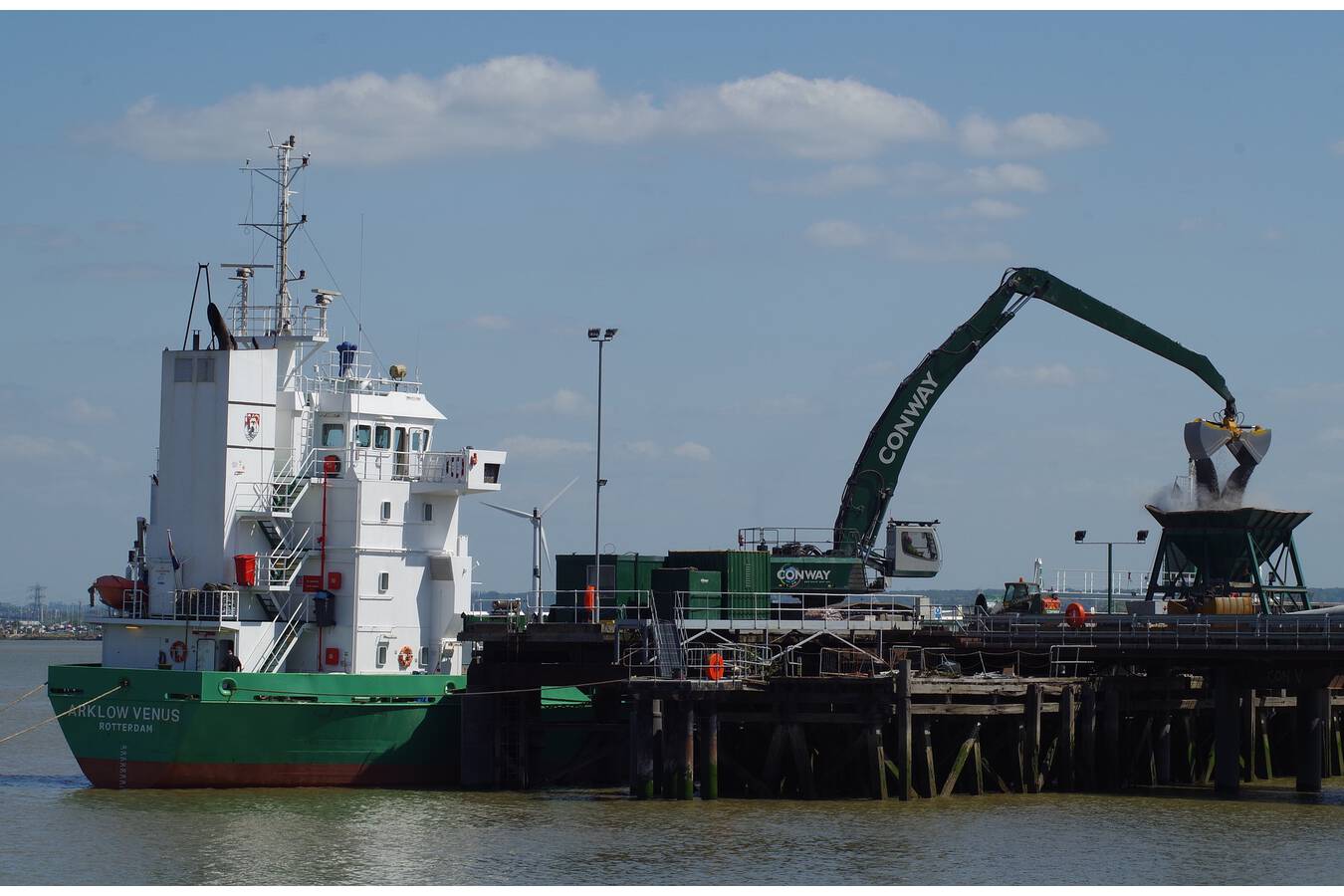
The Wolfson Centre for Bulk Solids Handling Technology at the University of Greenwich offers short courses about safe transportation of bulk materials in ports and at sea. The issues surrounding the safe handling and storage of bulk materials at port and at sea is examined during 2 on-line short courses; one looking at general safety issues, the other concentrating on the difficulties encountered when handling and transporting biomass materials. We invite you to attend. Port and Terminal Operations for Bulk Cargoes 8 - 11 March; This course, delivered in association with ABTO: Association of Bulk Terminal Operators, will take a look at the issues surrounding the safe handling and storage of bulk materials in ports and on the sea. Delegates are given the chance to discuss real life issues and to determine best practice for future developments. Subject areas covered include: * Ship unloading technologies (Grabs vs CSUs, different CSU technologies) * Conveying technologies (pneumatic vs belt) * Storage and discharge technologies (silos, flat stores, stacking etc) * Loading/unloading control (weighing, controlling ship bending etc) *…
19-02-2021  |  8099  |  product news  | 
Continue reading
Presentation Wolfson Centre at Powder Flow 2021 The Wolfson Centre for Bulk Solids Handling Technology will be presenting a paper at Powder Flow 2021.  And have a `remote` stand to be able to answer your questions
Presentation Wolfson Centre at Powder Flow 2021
The Wolfson Centre for Bulk Solids Handling Technology will be presenting a paper at Powder Flow 2021. And have a `remote` stand to be able to answer your questions The Wolfson Centre for Bulk Solids Handling Technology is proud to present at Powder Flow 2021, on 9 - 11 March 2021 Register to hear our Vivek Garg present his paper `A novel approach to predict the powder flowability from milligramme samples` Also presenting are: Dr Diego Barletta | University of Salerno Dr Mehrdad Pasha | USB Prof. Christine Hrenya | University of Colorado Boulder Dr Vincenzino Vivacqua | Johnson Matthey Prof. Jerry Heng | Imperial College Dr Enrico Gallino | Ricoh uk products Ltd We will be attending a `remote` stand to be able to answer your questions. We look forward to seeing you there.
22-01-2021  |  3072  |  press release  | 
Continue reading
PHD Studentship Sponsored by Schenck Process UK Ltd Join a study into Improving the efficiencies of manufacturing through the implementation of digital systems in pneumatic conveying pipelines
PHD Studentship Sponsored by Schenck Process UK Ltd
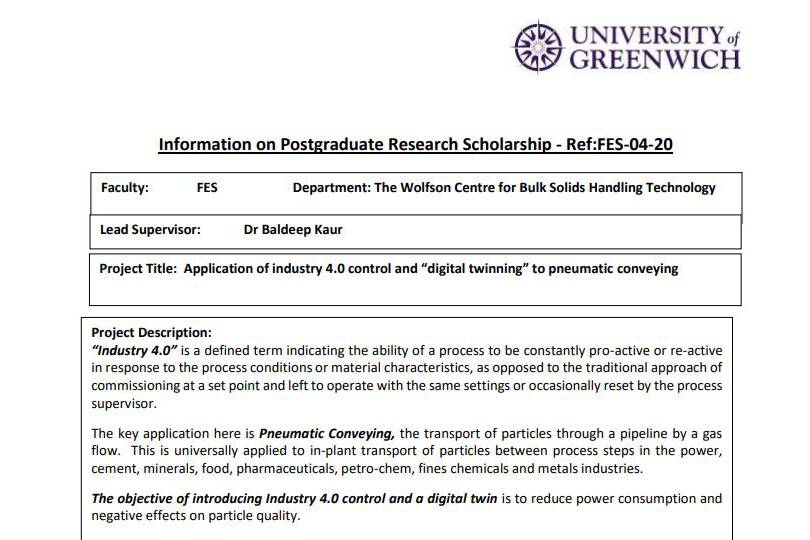
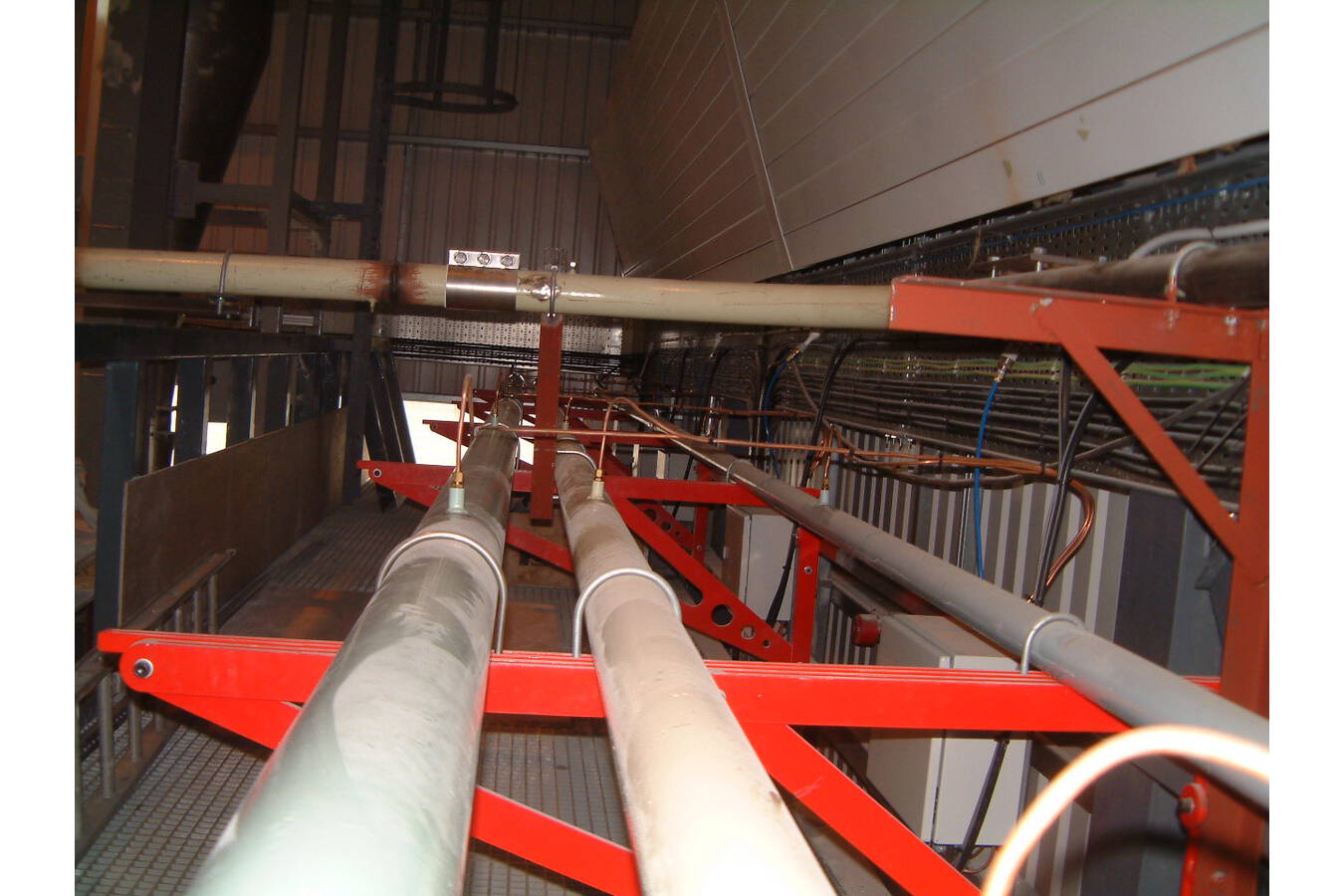
Join a study into Improving the efficiencies of manufacturing through the implementation of digital systems in pneumatic conveying pipelines Experts at the Wolfson Centre for Bulk Solids Handling Technology, University of Greenwich, UK have joined forces with Industry giants Schenck Process UK Ltd to offer a fully paid 3 year studentship to look at how the digitalisation of pneumatic conveying systems can help improve the manufacturing process. Constantly pro-active or re-active “Industry 4.0” is a defined term indicating the ability of a process to be constantly pro-active or re-active in response to the process conditions or material characteristics, as opposed to the traditional approach of commissioning at a set point and left to operate with the same settings or occasionally reset by the process supervisor. Pneumatic conveying The key application here is pneumatic conveying, the transport of particles through a pipeline by a gas flow. This is universally applied to in-plant transport of particles between process steps in the power, cement, minerals, food, pharmaceuticals, petro-chem, fines…
18-12-2020  |  8030  |  press release  | 
Continue reading
On line learning; Pneumatic Conveying of Powders and Bulk Materials Short Course; 6 - 12 January
On line learning; Pneumatic Conveying of Powders and Bulk Materials
Short Course; 6 - 12 January An intensive course looking at the components of pneumatic conveying systems, system selection and design techniques. Day 1: Introduction to pneumatic conveying / Components Day 2: System design / Economic design Day 3: Interfacing / Explosion hazards / ATEX-DSEAR Day 4: Operation and control of blow tanks / Blow tanks and transport Day 5: Uprating systems / Case studies Each session will include time to discuss operational issues with the presenter and other delegates. A previous delegate said of the course: This course demonstrated to me that an appropriate scientific approach can help to understand this art of pneumatic transport. I recommend this training to engineers who want to tackle powder conveying problems (design and operation) in their factory. Should I attend? If you are a plant designer, plant manager or work in maintenance, this course will improve your ability to deal with the design and troubleshooting of plants. You’ll also benefit…
16-12-2020  |  7335  |  product news  | 
Continue reading
Which type of Rotary Valve should I select? Short course: Rotary Valves; Design, Selection and Operational Issues
Which type of Rotary Valve should I select?
Short course: Rotary Valves; Design, Selection and Operational Issues 15 – 16 December 2020 On-line delivery: 14 :00 – 17:00 hrs UK time Which type of Rotary Valve should I select? Faced with a large choice of rotor type, drive type, venting arrangements, bearing pattern, seal choice, clearances, cleaning features etc, never mind the choice of materials of construction, how does an engineer decide which type of rotary valve to select? The course is aimed to help delegates understand the reasons for the different options and how to choose them and is recommended for engineers involved in the design of pneumatic conveying systems. Held over two short sessions, we have prepared the following programme. Programme * Application areas for rotary valves, and their different demands (feeding, explosion protection, isolation etc) * Basics of rotary valve performance – air leakage, feed rate etc * Materials of construction linked to issues of wear and build-up * Seals and bearings, options, functions and selection * Special…
13-11-2020  |  1618  |  product news  | 
Continue reading
PORTALS
BulkSolids-Portal Schuettgut-Portal Recycling-Portal
Related
Bulkgids.nl
SIGN UP FOR OUR NEWSLETTER
Newsletter archive
Service and contact
About, ContactDisclaimerPrivacyAdvertisingControl panel login
Follow us
Linked