Supplier sign in
Home
STAY INFORMED
Subscribe to our monthly newsletter.
Your email address will never be disclosed to any third party.
Read our privacy notice.


Specialist article
10.02.2026  |  82x
Share this item
Hygienic packaging for food

Hygienic Design in the Food Industry

How hygienic equipment design improves safety and efficiency in bulk solids filling

Hygienic production conditions are a fundamental requirement in the food industry to ensure product safety, quality, and stable processes. Especially in the handling and filling of powdered bulk materials, product residues, dust emissions, and hard-to-clean machine areas pose significant risks. Hygienic design therefore follows a constructive approach aimed at eliminating potential sources of contamination already during the design phase of machines and systems.

Hygienic design as an engineering principle

Hygienic design refers to the consistent hygienic construction of machine components, surfaces, and transitions. The objective is to avoid dead spaces, horizontal surfaces, and complex geometries that are difficult to clean. Smooth, closed surfaces, radial transitions, and fully drainable components significantly reduce product adhesion and simplify cleaning procedures.
In bulk solids filling applications—such as milk powder, cocoa, starch, or protein-based ingredients—this type of design helps minimize microbiological risks and ensures reproducible hygiene standards.

Regulatory requirements and audit readiness

Food manufacturers are subject to a wide range of national and international regulations. Hygienic design supports compliance with relevant requirements such as EU Regulation 1935/2004, GMP guidelines, and HACCP concepts. A risk-based design approach allows potential contamination points to be identified early and addressed through appropriate engineering measures.
Another key advantage is improved audit readiness. Equipment that is clearly structured, easily accessible, and designed for hygienic inspection simplifies both internal and external audits and reduces the organizational effort required in quality management.

Technical solutions for critical process points

In practice, hygienic design becomes particularly relevant at sensitive process areas such as the filling zone, component interfaces, or bag sealing. Integrated aspiration systems can significantly reduce dust emissions and help prevent cross-contamination within the production environment.
Packaging integrity also plays a critical role. Reliable sealing technologies ensure that product losses are avoided and hygienic conditions are maintained throughout transport and handling. In addition, sensor-based monitoring systems allow continuous control of critical process steps.

Cleaning as an efficiency driver

A major economic benefit of hygienically designed equipment lies in cleaning efficiency. Smooth surfaces, good accessibility, and complete drainability significantly reduce cleaning time. Optional integrated wet cleaning systems enable automated and documented cleaning processes—particularly beneficial for frequent product changes or allergen-critical applications.
Reduced downtime, lower consumption of cleaning media, and higher equipment availability directly improve operational efficiency and contribute to a lower total cost of ownership.

Hygienic design as a competitive factor

Beyond food safety and efficiency, hygienic design is increasingly becoming a strategic differentiator. Clean processes, dust-free packaging, and consistent product quality positively influence the market perception of manufacturers and strengthen trust among customers and partners.
Modular equipment concepts allow hygienic requirements to be flexibly adapted to different bulk materials and production conditions. As a result, hygienic design becomes a key element for future-proof, high-performance filling solutions in the food industry.

Learn more

The whitepaper “Hygienic Design in the Food Industry” provides an in-depth overview of hygienic equipment design principles for powder filling applications. It explains how well-engineered machine design helps improve food safety, reduce cleaning effort, and increase process reliability in food-grade production environments.

Download the whitepaper now, through the link in the box on the right.

Company information

More items

Food Connect 2025: Networking Event for Food Filling Experts At Food Connect 2025 in Lübeck, Greif-Velox presents state-of-the-art automation for food filling, including a wet-cleaning line for Lactoprot that prevents allergen cross-contamination during product changes.
Food Connect 2025: Networking Event for Food Filling Experts
At Food Connect 2025 in Lübeck, Greif-Velox presents state-of-the-art automation for food filling, including a wet-cleaning line for Lactoprot that prevents allergen cross-contamination during product changes. The Food Connect 2025 hosted by Greif-Velox on November 13, 2025 in Lübeck will focus on automation, process safety, and efficiency in food filling and packaging. Through live demonstrations, the company will showcase two highly automated packaging lines featuring the BVP and BVPV gross pneumatic packers, combining automatic product changeover, central line control, open interface connectivity, and intelligent pallet management. A special highlight is the custom line developed for Lactoprot, equipped with an integrated wet-cleaning system that prevents allergen cross-contamination – setting new standards in hygiene and efficiency. In addition to technical demonstrations, participants can expect an inspirational keynote on the future of food filling and plenty of opportunities for networking and professional exchange. Start: 10:30 AM | End: approx. 2:45 PM
23.10.2025  |  754x  |  Press release  |   | 
95% less material waste during starch bagging AKD Toftlund (Denmark) was able to reduce the reject rate from 0.8% to just 0.04% using the GREIF-VELOX ValvoDetect sensor system.
95% less material waste during starch bagging
AKD Toftlund (Denmark) was able to reduce the reject rate from 0.8% to just 0.04% using the GREIF-VELOX ValvoDetect sensor system. Valve bags are widely used in automated packaging lines in the food industry – especially for products such as cornstarch – because they offer many advantages in terms of storage and handling. However, defective bags or bag valves repeatedly cause significant disruptions in the filling process. A common scenario: The valve sticks to the bottom of the bag and cannot be opened correctly automatically during filling. As a result, the bag cannot be filled completely or at all. This leads to product losses, dust contamination, additional cleaning effort – and ultimately an unnecessarily high proportion of rejects. GREIF-VELOX expanded the BVPV 4.40 to include the high-precision ValvoDetect sensor system, which works in two test stages: # Variant Save: Even before the filling process, optical sensors check whether the bag valve has been opened correctly as soon as the bag sits on the spout. Faulty bags are ejected immediately. # Variant Clean: Before the sealing
03.07.2025  |  1601x  |  Press release  | 
Powder bagging on subscription - without any investment Packaging machine specialist Greif-Velox launches “Packaging as a Service” for the bagging of ultra-light powders
Powder bagging on subscription - without any investment
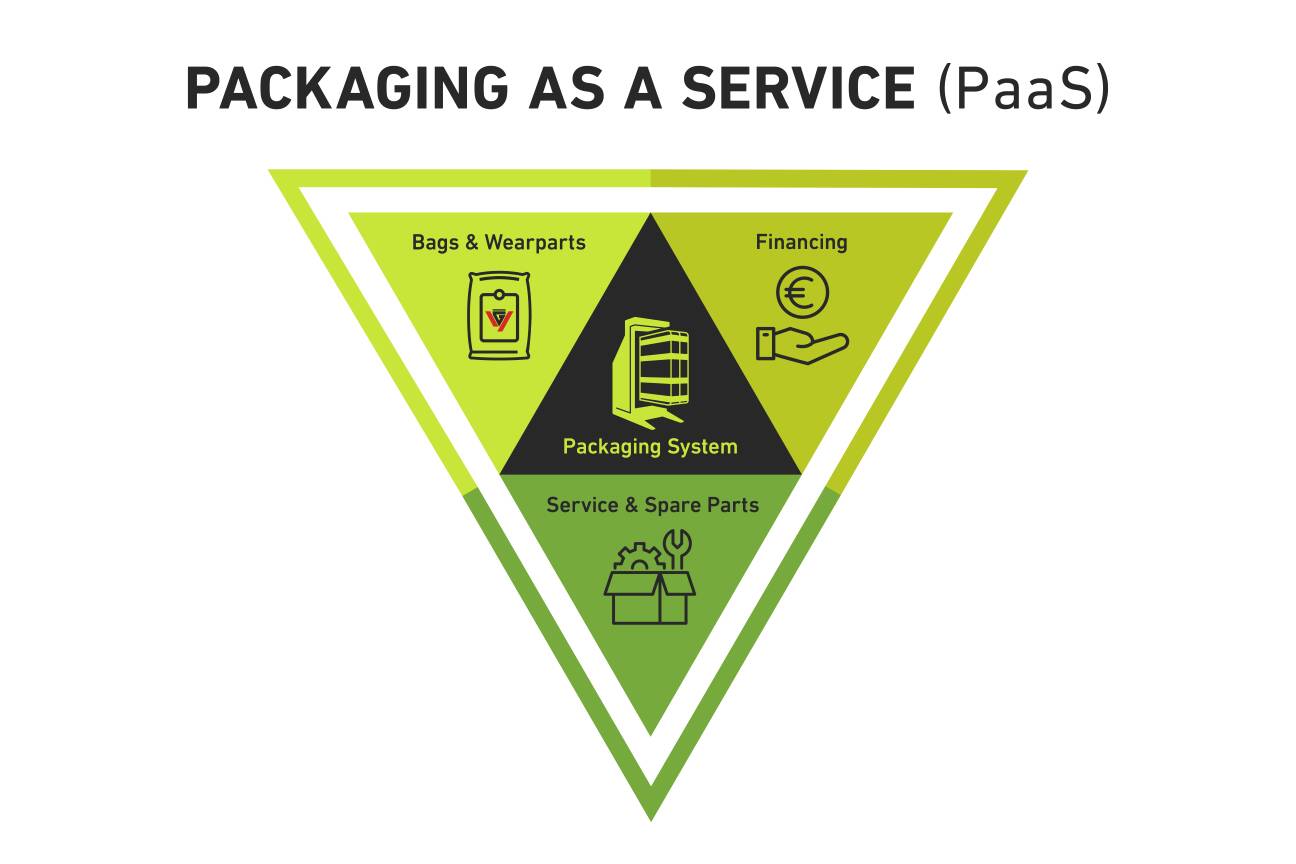
Packaging machine specialist Greif-Velox launches “Packaging as a Service” for the bagging of ultra-light powders With a new “Packaging as a Service” (PaaS) model, Greif-Velox Maschinenfabrik GmbH is offering an integrated service package for industrial powder bagging without any initial investment for the first time. The offer includes machine provision, financing, service, spare parts and merchandise parts as well as the supply of suitable paper bags as required - at a fixed monthly price. End-to-end solution for ultra-light powders While previous PaaS models in the packaging industry were limited to cardboard or reusable packaging solutions, GREIF-VELOX transfers the principle to complex industrial bagging systems - and goes one step further: the package not only includes consumables, but also the entire process from financing to commissioning and spare parts supply. The first application is in combination with VeloVac vacuum technology for dust-free filling of ultra-light powders. An expansion to other machine types such as the A-DOS-P1 and the BVP gross pneumatic packer
06.05.2025  |  3966x  |  Product news  | 
PORTALS
BulkSolids-Portal Schuettgut-Portal Recycling-Portal
Related
Bulkgids.nl
SIGN UP FOR OUR NEWSLETTER
Newsletter archive
Service and contact
ContactDisclaimerPrivacyAdvertising
FOLLOW US
Linked