Potash Compaction: 10 Levers That Decide Every Circuit’s Stability
Potash compaction: 10 critical levers - from press force to the screening machine as the value-adding machine that keeps the circuit stable.
In potash compaction, nothing is a minor detail. A single weak point is enough to throw the entire granulation circuit off balance - here, small causes produce large and costly effects. From press force and roller wear to the screening machine that acts as the true ”value-adding machine”: we have compiled the 10 decisive points that really matter.
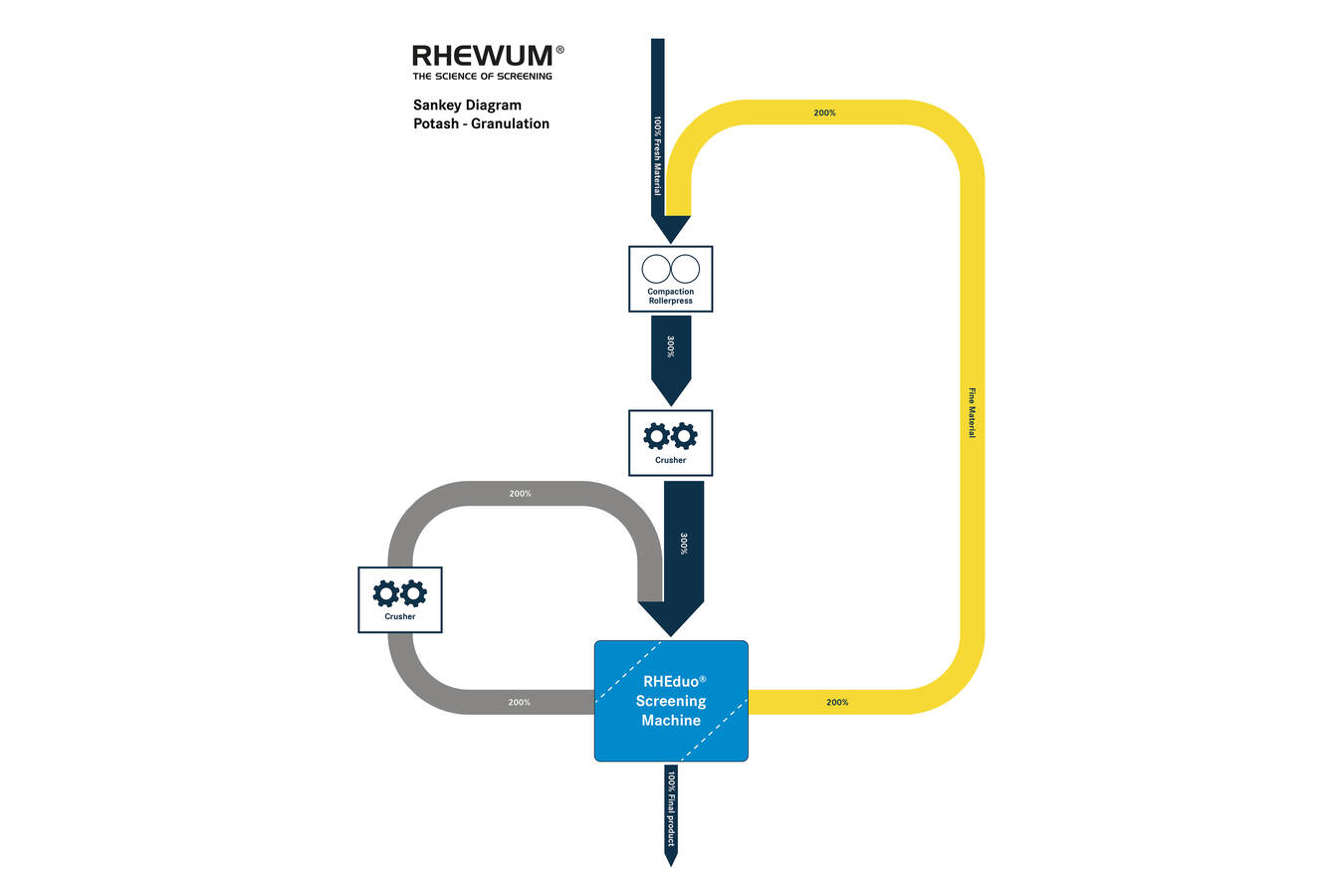
The granulation circuit in potash compaction does not run linearly - it forms a self-contained system in which every process step feeds back into all the others. Roller press, impact mill, and screening machine are so tightly interlinked that a single weak point can put the entire production process at risk. As specialists in precise screen classification, we support this circuit again and again at its most sensitive interface, which is why we know exactly which factors destabilize it. A compaction and screening circuit that ”runs out of control” overloads the roller press, which - as the most expensive single machine - then limits the performance of the entire circuit. The basic rule is: small influences have large, and expensive, effects.
01 Flake Quality: It All Comes Down to Pressure
The roller press compacts the fine salt under high pressure into a solid flake. If this press force is too low, the flake crumbles into fines rather than granulate in the downstream impact mill. These fines return to the fine-salt circuit after screening and unfavorably shift the ratio of fines to fresh salt - which further weakens the next compaction pass. This creates a self-reinforcing vicious circle that can push the mass yield below 20 % and overrun the roller press.
02 Press Force: Too Little or Too Much - Both Cost Performance
The ideal working pressure of a roller press depends on material temperature, particle size distribution, and moisture, and for potash it typically ranges between 30 and 50 kN/cm. If the pressure is too low, brittle flakes with a high fines content result; if it is too high, the rollers wear out faster and energy consumption rises unnecessarily. The hydraulic system, which also acts as a safety valve against foreign bodies, must therefore be permanently monitored and continuously adapted to the process conditions.
03 Roller Wear: The Concave Profile as a Creeping Adversary
Even a well-adjusted press wears out unnoticed. The constant abrasion from the potash salt gradually shapes a concave roller profile - the press force then distributes unevenly across the roller width, and weak flakes form in the widened press gap. Some manufacturers use specially hardened roller tires, but even optimized surfaces are not spared from wear and axle deflection. A worn profile often only becomes apparent once the circuit has long since become unstable.
04 Impact Mill Blow Bars: Sharp or Blunt?
Sharp-edged blow bars strike the pre-broken flake centrally and, through targeted impact stress, reduce it in a controlled manner to the target grain size of 2 to 4 mm. Once the bars are worn, uncontrolled edge impacts replace the clean impact fractures - the fines content rises, the granulate content falls. Both reduce plant performance. The wear progresses gradually, yet its effect on the circuit is exponential: more fines mean more recirculation, less throughput, and poorer flakes.
05 | Fine-Salt Circuit Ratio After Screening: The Hidden Control Variable
How well the mixture can be compacted in the roller press depends decisively on the ratio between recirculated fines and fresh fine salt from drying. An excess of fines worsens compactibility; too little leads to air inclusions and thus to unstable flakes, which generate unnecessary undersize in the downstream flake crusher. Anyone who continuously measures this ratio and actively controls it via metering devices holds one of the most effective levers for product quality and mass yield.
06 Circuit Overflow: When the System Tips Over
If more material is produced in the circuit than can be discharged - for example, through excessive fines formation, clogged screen media, weak flakes, or over-ground flakes - the circuit sometimes overflows for hours and overloads all of its aggregates. The real problem is the positive feedback: once out of balance, the disturbance amplifies itself, and normal operation can only be restored with considerable effort. The only reliable way to prevent this is continuous monitoring with automatic control of the material flows - along with a correctly dimensioned screening machine as the only discharging component of the circuit.
07 Mesh Size: What You Don’t Know Costs Performance
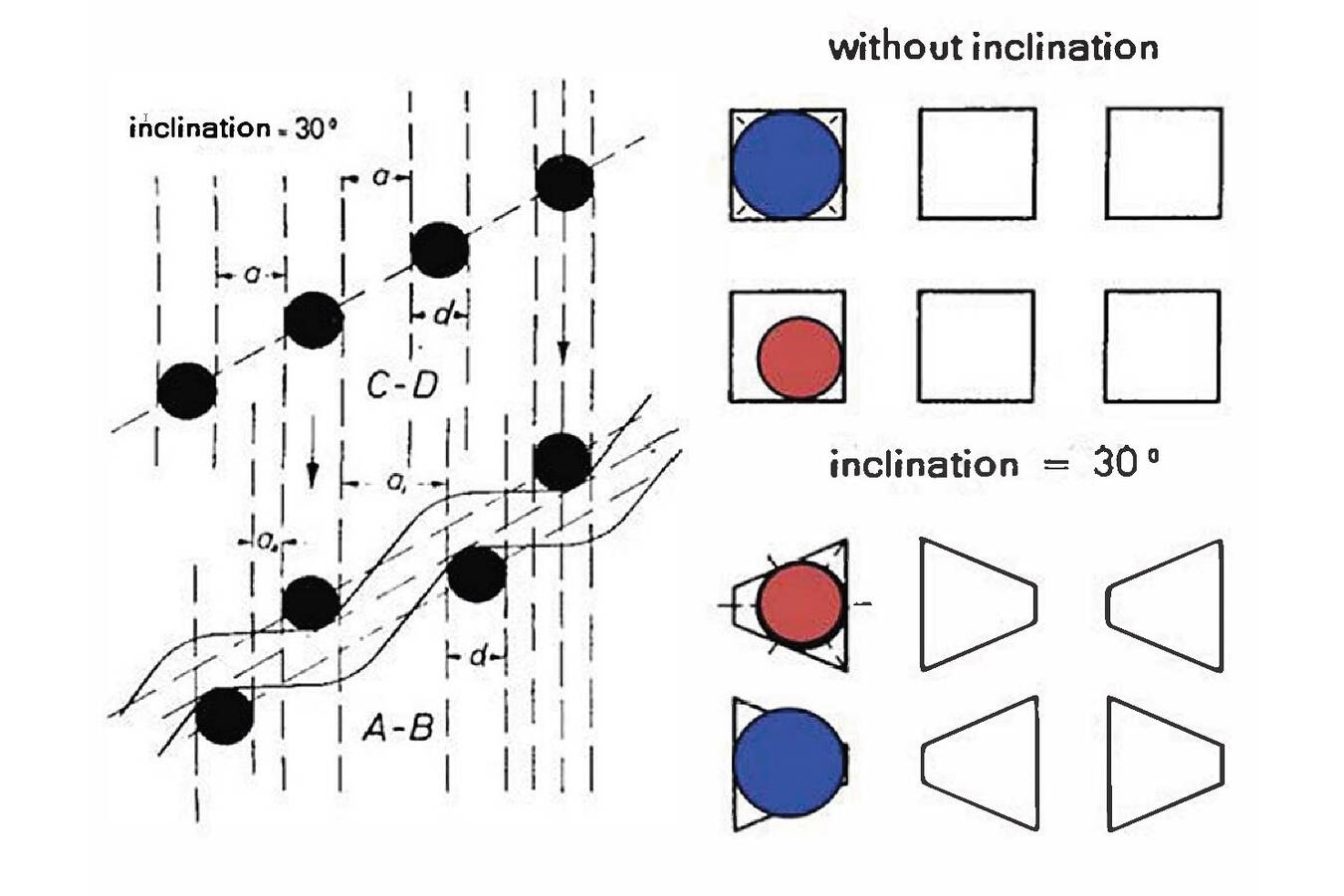
The right mesh size is anything but a minor matter: at typical flake throughput, a deviation of just 0.35 mm in the lowest screen deck is enough to send large quantities of usable granulate wrongly into the fine-salt circuit - an immediately measurable economic loss. And the mesh shape? Square meshes tend to clog with granular potash, whereas rectangular meshes deliver considerably more stable results at the same separation sharpness. RHEWUM tests different mesh types on the real product in advance to keep good-grain losses and clogging tendency as low as possible.
08 Near-Mesh Particles: The Open Screen Mesh Is Decisive
Particles whose size is just about the mesh opening become lodged and block the usable screening area. With hygroscopic potash salt, these near-mesh particles additionally swell slightly and clog the meshes, which intensifies the effect further. The RHEWUM screening machines of the RHEduo® and RHEduox® series counter this with generously dimensioned screening area and an integrated screen mesh cleaning system. As a result, the mesh stays permanently open even with difficult, hygroscopic products - without any production downtime. If the screen mesh clogs, however, a product overflow quickly occurs, overloading the downstream units.
09 Defective Screen Media: The Silent Quality Killer
Cracks, broken meshes, or widened mesh openings lead to misclassification: grain that is too coarse migrates into the fines, grain that is too fine into the product - both burden the circuit, dilute the specification, and disrupt the circulating load. Defective screen media must be replaced immediately, because a damaged deck overloads the neighboring screening areas and systematically widens the damage. Anyone who keeps replacement mesh in stock as standard protects themselves against unplanned downtime, which in the case of a mesh tear can quickly last several hours - and whose delivery times can sometimes amount to several weeks.
10 Screening Machine Dimensioning: This Is Where Value Is Created
The screening machine is the only aggregate in the circuit that discharges product - and thus the only one that creates real value. Roller press and impact mill prepare; the screening machine decides. It is not a downstream sorting tool but the quality filter of the entire system. It compensates for what the compaction does not deliver perfectly: fluctuating press force, incipient roller wear, and changing moisture lead to a broader grain distribution - a precise, stable screening prevents these process fluctuations from directly affecting product quality. Anyone who sizes the screening machine only for normal operation instead of for the worst case creates exactly the bottleneck that provokes the circuit overflow in the first place - and that then amplifies itself. Screening area, machine technology, and cleaning must therefore be designed for the most difficult material and the highest circulating load. Because only here does fine salt become a marketable granulate - this is not a cost center but the value-adding machine of a functioning process.
The potash compaction circuit forgives no half measures. Each of the ten points can destabilize operations on its own - in combination, their effects multiply. RHEWUM develops screening solutions that do not start only at the end of the chain but keep the entire circuit in view: from the right mesh geometry and reliable self-cleaning to integrated material distribution and a screening solution with the necessary performance reserves.