Why Every Clay Court Is Born in the Screen Mesh - The Hidden Process
Why the red surface of Roland Garros isn’t sand: how precise screening with RHEWUM technology decides the quality of every tennis court.
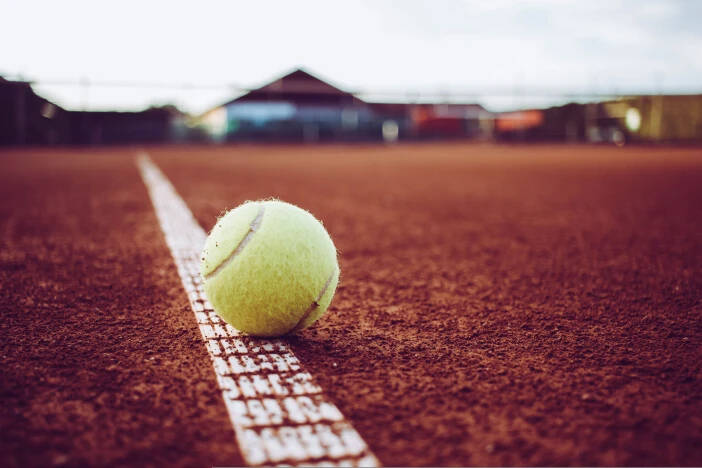
The red surface of Roland Garros isn’t sand - it’s finely ground brick. And its quality isn’t decided by the groundskeeper, but by the precision of the screening.
When Alexander Zverev let himself fall backwards into the red clay of Roland Garros on 7 June 2026, hands covering his face, a long-awaited chapter was written: his first Grand Slam title, claimed in a five-set thriller against Flavio Cobolli - and the first German men’s triumph in Paris since Boris Becker in 1996. A day earlier, on the women’s side, the just 19-year-old Mirra Andreeva had celebrated her own victory. Beyond the sporting drama, one very sensory image stays with us: the controlled slide into the forehand, the swirling red dust cloud, the distinctive smell of damp ash. Anyone who has ever played on ”clay” knows it well. Except it isn’t sand at all. And the character of this surface is determined long before the first serve - in an industrial production process of crushers, conveyor belts and high-precision screening machines.
Not Beach Sand, but Fired Clay
What crunches beneath the tennis shoes is ground brick. Tennis clay - also known as brick dust or tennis sand - is made from single-grade fragments of fired clay bricks: roof tiles, clinker, masonry bricks, often defective batches straight from the brick industry. Binders such as lime or cement are deliberately left out. The red surface holds together purely through the right grain composition. Good tennis clay combines different firing hardnesses: hard roof-tile fragments provide wear resistance, while a share of softer masonry brick delivers binding and the characteristic bright red. German clubs alone play through around 100,000 tonnes of it every year.
From Coarse Chunk to Defined Grain
The path there begins anything but delicately. A wheel loader delivers the fragments into the feed hopper and on into the crusher, which breaks the material down. But crushing alone does not make a playable court - what comes out first is a wild mix of every grain size imaginable. Only classification, meaning separation by grain size, turns this bulk material into a defined product. It is precisely at this point that the decision is made whether a court will later be playable or not.
Grain Size Decides Everything
Tennis clay is manufactured to DIN 18035-5 with quality assurance to RAL-GZ 515/1; common final grain sizes are 0/2 and 0/3 mm. The standard requires not just a single grain size, but a complete grain size distribution with tight tolerances. Put simply: the fine fraction below 0.06 mm stays limited, the medium fine range from 0.06 to 0.70 mm dominates at around 40 percent, and the coarser grain remains in the minority. Water permeability, frost resistance, wear resistance and shear strength all depend directly on this distribution. Too much fine grain, and the court becomes dense and unstable. Too much coarse grain, and both appearance and shear strength suffer. The clean slide, the even bounce behaviour, and the puddle that seeps away within minutes after rain - all of it is the result of sharp separation, controlled through screen surfaces with mesh sizes of just a few tenths of a millimetre.
The Supreme Discipline: Fine Screening
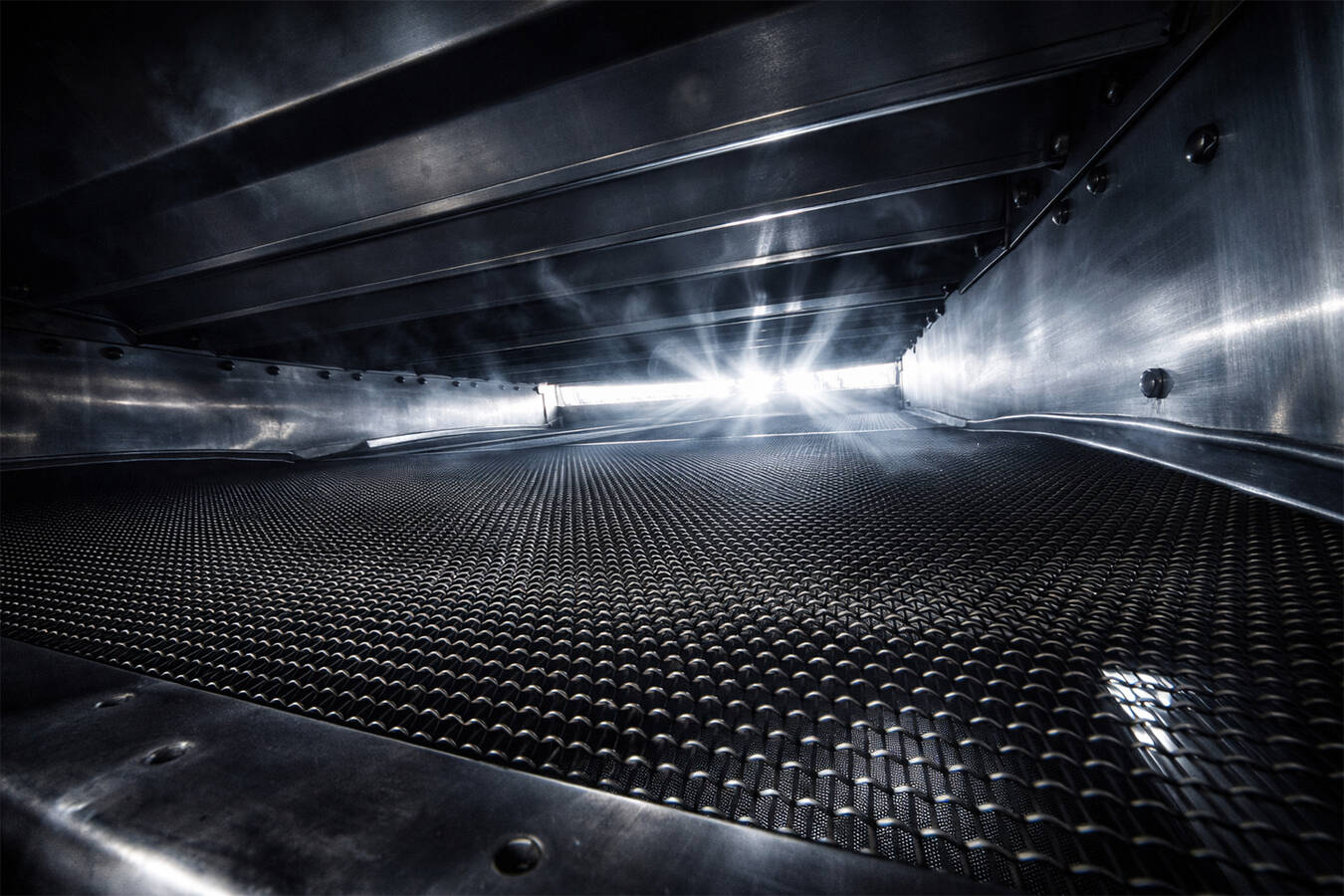
In process engineering terms, brick dust is a demanding feed material. It is naturally moist and hygroscopic, in other words essentially sticky. Moisture combines with dust and fine content into agglomerates that cling to the screen mesh and clog it, unless the machine has an effective self-cleaning system. Trapped grain then blocks the fine meshes, the separation cut shifts, and the product falls out of spec. As a rule of thumb: the wetter the raw material and climate, the faster the screening machines clog - and the finest screen decks are hit fastest of all. In the coarse range, robust, simple vibrating screens are sufficient: two externally mounted unbalance motors set the entire machine into a linear vibration and handle the coarse separation. But the finer the separation cut needs to be, the less it helps to simply shake the housing. The decisive acceleration has to go exactly where the separation actually happens - directly into the screen mesh. That is precisely what direct screen mesh excitation achieves. Externally mounted magnetic vibrator heads transmit a high-frequency vibration directly onto the screen surface, while the housing remains static. Accelerations of up to 50 g arise at the mesh, and regular automatic cleaning impulses free it from trapped grain. This way the surface keeps itself clear during operation - and the separation cut stays exact for weeks. In the RHEWUM RHEsono series, this principle is implemented consistently; it separates precisely exactly where the quality of the tennis clay is decided. Where space is tight, the RHEsonox combines both worlds - linear vibration and mesh excitation - within a low overall height, separating from around 50 µm up to 6 mm. Because only the mesh vibrates, moving mass, energy consumption and dynamic loads remain low. In addition, the static housing can be built dust-tight and connected to a dust extraction system - with respirable brick dust, an immediate matter of occupational safety.
The Science of Screening
And here lies the real point. Before the screen, the material is little more than broken brick, often a worthless defective batch. After the screen, it is a standardised, high-quality building material that determines the playing properties on thousands of courts. This transformation is delivered by separation - screening is the value-adding process step. Hardly anyone knows RHEWUM. Yet what our machines screen is everywhere: in the plaster on the wall, in the fertiliser on the field, in the sugar on the dining table - and, indeed, in the red dust beneath the feet of tennis professionals. We don’t stand in the spotlight. But we are successful, because we make our customers successful. The perfect clay court doesn’t begin on the tennis facility. It begins in the screen mesh.