Supplier sign in
Home
STAY INFORMED
Subscribe to our monthly newsletter.
Your email address will never be disclosed to any third party.
Read our privacy notice.


Product news
07.04.2025  |  2425x
Share this item
Allow (tracking) cookies from YouTube and Vimeo to watch videos

Fully Automatic Bigbag Crusher: Consistent FIBC Conditioning

Based on the success of previous models, Jansen&Heuning now offers a fully automatic bigbag crusher — the most efficient way to condition bigbags.
In bulk solids handling, compacted materials within Flexible Intermediate Bulk Containers (FIBCs) can significantly disrupt production lines. Jansen&Heuning’s Fully Automatic Bigbag Crusher provides a robust and intelligent solution, conditioning hardened contents swiftly, safely, and hands-free at the touch of a button.

Automated Crushing for Maximum Efficiency

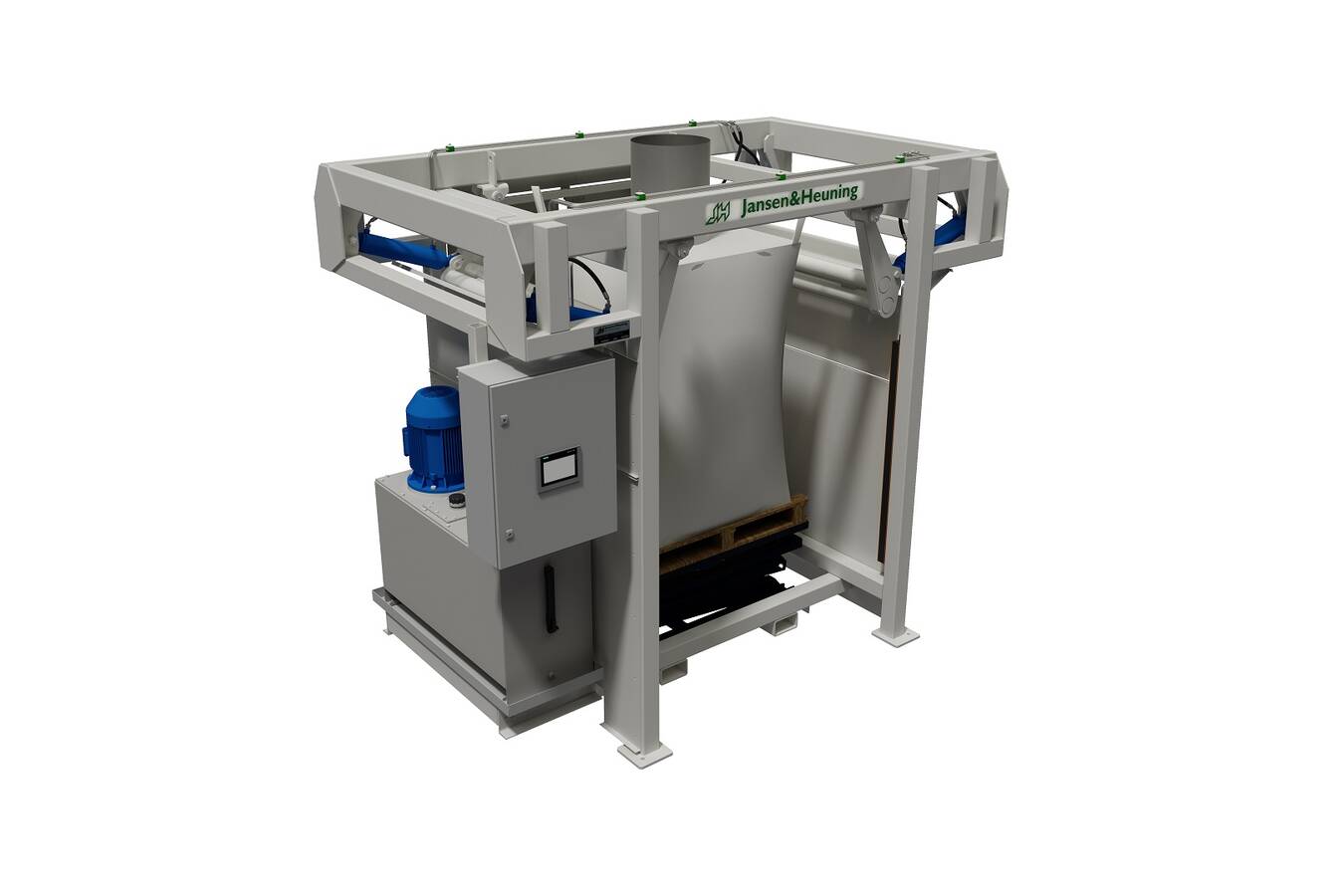
Engineered for demanding industrial applications, this bigbag crusher employs hydraulic force and programmable motion to compress FIBCs from multiple sides and heights. A rotating scissor lift table and two hydraulic pressing arms work in unison to break down compacted materials into a flowable form.

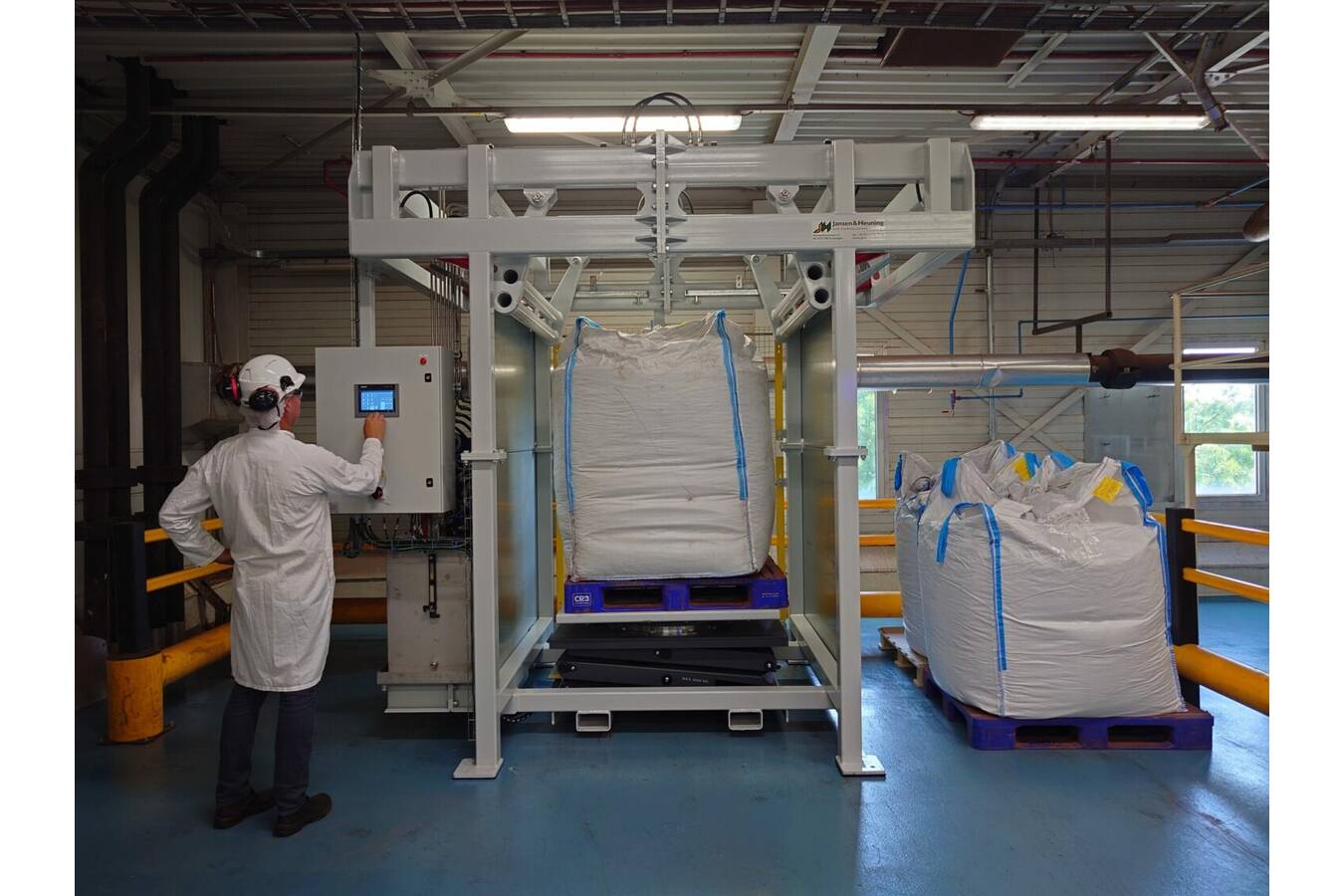
Operators position the bigbag on the lifting table using a forklift. After selecting a pre-set or custom program via the integrated HMI touchscreen, the crushing cycle commences. The bigbag undergoes compression in up to 12 programmable steps, with the table rotating 90° to ensure thorough conditioning from all sides.

Programmable Precision
Each crushing program can be customized to accommodate specific material characteristics. Users can adjust:
  • Pressing force
  • Height between compression steps
  • Rotation behavior of the turntable

This flexibility ensures optimal performance across a diverse range of materials, from hygroscopic powders to recycled feedstock.

Safety and Integration

Delivered fully assembled and tested, the machine features built-in operator protection via a light curtain. For enhanced safety, optional fencing is available to restrict access during operation.

The fully automatic crusher can be seamlessly integrated into existing unloading lines, particularly when combined with Jansen&Heuning’s bigbag filling and unloading stations. An elevated version is also available for larger FIBCs (up to 2.2 meters high), alongside semi-automatic and mobile models for more flexible setups.

Whether for food, chemicals, recycling, or bulk materials processing, the Fully Automatic Bigbag Crusher delivers unparalleled automation, safety, and adaptability. By minimizing manual handling and effectively conditioning bigbags, it ensures consistent material flow and increased productivity — all with a single push of a button.


Company information

More items

Reduction of dust emissions during ship loading Dust emissions during ship loading are often a burden on the environment. It is possible to minimise dust emissions by fairly simple means.
Reduction of dust emissions during ship loading
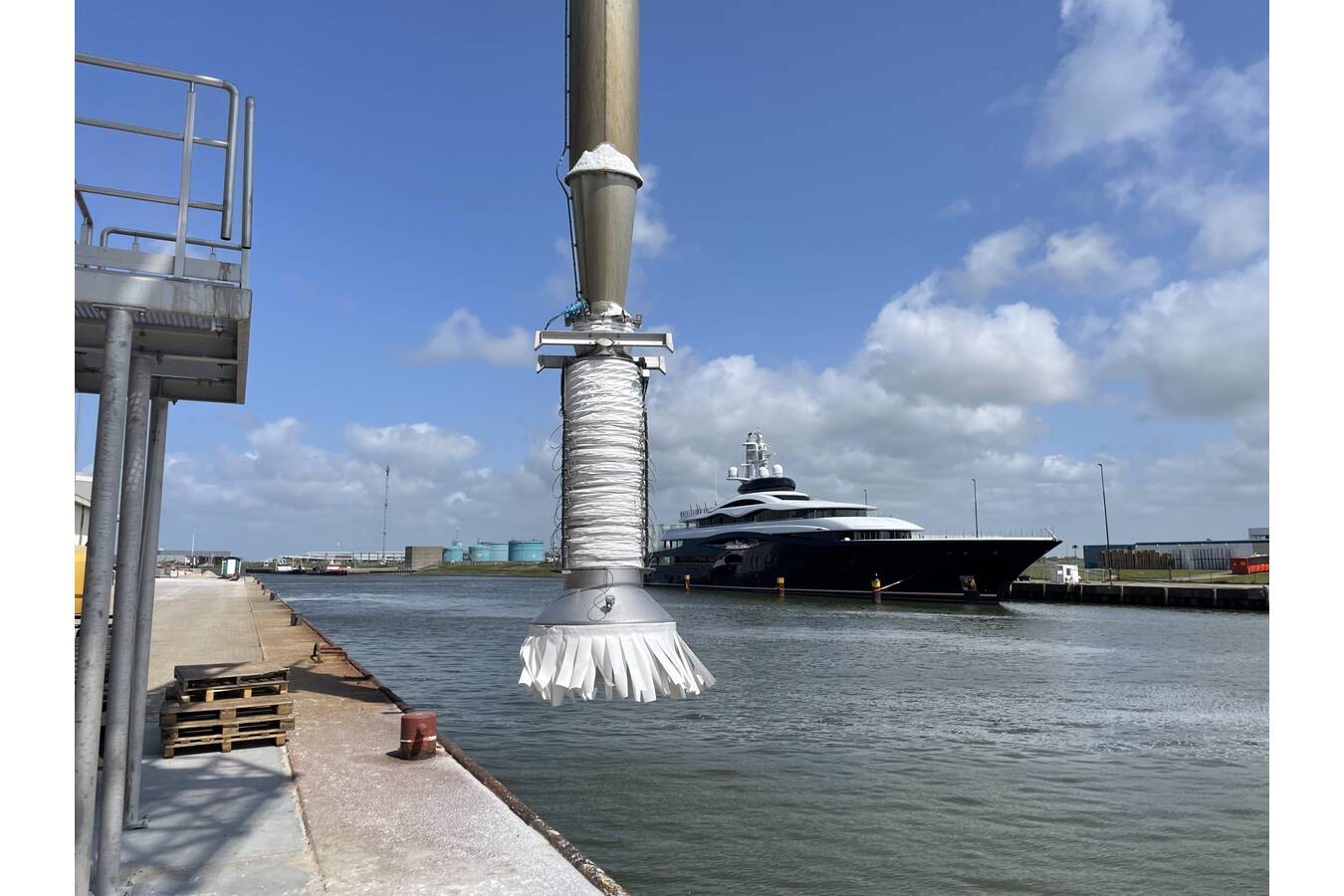
Dust emissions during ship loading are often a burden on the environment. It is possible to minimise dust emissions by fairly simple means. When loading ships, product flows down a loading pipe from a great height and gains a lot of speed. When the material flow collides with the product mountain in the ship’s hold, a lot of energy is released. This leads to violent movement of the material, which can stir up a lot of dust. The loading pipe (or loading conveyor) is often telescopic and pivoting, in order to load the vessel as efficiently as possible. Sometimes a dump pipe is used, equipped with a loading bellows at the end. To minimise dust generation, two basic solutions are possible, which can also be applied in combination: * A sealing of the product surface and possible extraction. * A speed reduction of the material flow from the loading pipe. Reducing dust emissions with dust skirt An example of closure is the deployment of a dust skirt under the spout. An automatic height adjustment ensures that the skirt rests on the product surface. A well-designed dust skirt is very effective, especially
06.01.2025  |  2100x  |  Press release  | 
Bucket elevators, an efficient solution
How can you use your expensive soil economically efficient? This is possible with a bucket elevator. If you raise your product with an elevator to a height of, for example, 30 meters, you only need a ground surface of approximately 2 m². A belt conveyor quickly reaches a length of 60 meters, with supports the surface area needed will easily be 120 m². What you need for a bucket elevator * a good foundation * a metered supply of product * lateral support per 10 meter height Suitable means of transport The bucket elevator has already proven its value as an extremely reliable means of transport for the transport of dry materials such as grains and flours. Due to the development and application of rubber belts and plastic inserts, there is hardly any elongation and the powers to be transferred have been greatly improved. Because of this and the use of modern plastic cups, the elevator is also very suitable as a means of transport for sand, gravel and other abrasive
05.11.2024  |  2951x  |  Insight  | 
Durability of chain conveyors, a practical case Long service life and lower energy consumption by using a plastic base plate. 15 year of mais conveying proves the benefits.
Durability of chain conveyors, a practical case
Long service life and lower energy consumption by using a plastic base plate. 15 year of mais conveying proves the benefits. By applying a complete plastic wear plate to the base of the chain conveyor, a long service life of the base is achieved. The chain is supported over the entire surface and not only glides over the chain links, but the flights also carry along. Energy consumption has been shown to be around 20 % lower than with other systems. The friction of the product over the plastic is lower than over steel. An example of the service life We supplied chain conveyors to Tate & Lyle for their maize soaking tubs. After 15 years, we had to replace the plastic floor of the main distribution chain. There, 1,300 tonnes of maize are handled every day, 340 days a year, which is almost 5 million tonnes in total, and only then is the first simple maintenance of the plastic parts required. Maize contains a lot of sand and abrasive material.
03.09.2024  |  2400x  |  Product news  | 
How to reduce dust when handling bulk goods During transport of bulk solids dust is often released. Under health and safety regulations, companies are obliged to take action against this.

A high concentration of dust
How to reduce dust when handling bulk goods
During transport of bulk solids dust is often released. Under health and safety regulations, companies are obliged to take action against this. A high concentration of dust A high concentration of dust particles quickly leads to you having to take measures to combat dust. Simply handing out face masks is completely inadequate. More needs to be done. The government has stipulated how high the dust concentration may be in a room for each type of substance. If the inspection authorities identify that a room contains too much dust, they are obliged to take action. No need for expensive installations right from the start Fortunately, it is not necessary to buy an expensive extraction system straight away. Sometimes it is perfectly possible to adapt the product, business process or machine so that less dust is released. Contaminated air flow If all this is not enough, it is time to think about a way to eliminate the dust. If you opt for a system that extracts the dust via a filter, you can expect a polluted airflow. There are also regulations on how high the emissions may be. Particularly strict regulations apply to hazardous substances
08.07.2024  |  2673x  |  Insight  | 
Storage and loading of protein-containing meals Jansen&Heuning designed a logistic system for the processing of blood meal, meat meal and feather meal. Contamination was an important issue.
Storage and loading of protein-containing meals
Jansen&Heuning designed a logistic system for the processing of blood meal, meat meal and feather meal. Contamination was an important issue. For abattoir waste processor Noblesse, our engineers studied the processing of blood meal, meat meal and feather meal. In this process, contamination, among other things, had to be taken into account. How did they do this? At Noblesse proteins the existing production site had to be improved in terms of storage and loading. The available height is 11,000 mm at the ridge and 9,500 mm at the wall, the width of tents is 45,000 mm. The main challenge for our engineers was that it had to be possible to mix from all of the silos. In addition, we had to ensure two completely separate lines to prevent contamination. Finally, all silos had to be placed on load cells for the correct dosage. Objectives * Storage capacity: feather meal 300 tons; meat meal 600 tons; blood meal 60 tons * Loading with movable conveyor above the cars with loading bellows * loading with a capacity of 60-80 tons/hour The system consists of: * new silo block consisting of five silos of over
22.05.2024  |  2311x  |  Product news  | 
PORTALS
BulkSolids-Portal Schuettgut-Portal Recycling-Portal
Related
Bulkgids.nl
SIGN UP FOR OUR NEWSLETTER
Newsletter archive
Service and contact
ContactDisclaimerPrivacyAdvertising
FOLLOW US
Linked