Challenges of Industrial Dust
Wherever powdery goods are processed, dusts are an inevitable byproduct. Their problematic nature stems from their ability to escape through even the smallest leaks in equipment like big bags, mixers, silos, pipelines, and filling plants. Once airborne, dust can remain suspended for extended periods, settling on all surfaces, particularly horizontal ones. A sudden air current can easily re-suspend settled dust, creating a cycle of contamination. Furthermore, some dusts are hygroscopic, meaning they absorb moisture from the air, making surfaces sticky and difficult to clean. Salt dusts, for example, can also be corrosive. Beyond being a nuisance, dusts pose significant hazards; organic dusts, especially when fine and dry, can be both combustible and explosive. In the workplace, dusts invariably impact well-being and irritate the respiratory tract. Economically, escaping dust represents material loss and incurs disposal costs.
Nanoparticles and Their Applications
While consumer-grade powders are typically conditioned to minimize dust content, the realm of extremely small particles, known as nanoparticles, presents unique characteristics. Particles smaller than 0.1 µm are classified as nanoparticles. At this scale, many materials exhibit entirely new properties, opening doors for innovation across various fields. In medicine, powder metallurgy, electrical engineering, and high-performance ceramics, nanodisperse structures are instrumental in developing novel materials and functions. It’s important to note that as particle diameter decreases, the specific surface area and chemical reactivity increase logarithmically.
Effective Dust Binding Techniques
Effective dust binding is crucial for mitigating the issues associated with airborne particles. One highly effective method involves gently moistening bulk materials by distributing extremely small quantities of liquid into large volumes of powder. In equipment like amixon® mixers, dust emissions can be prevented by agglomerating fine dust particles or by causing them to adhere to larger particles. Even minute amounts of a suitable liquid can be beneficial, provided the liquid is distributed evenly across the entire surface of the bulk material. Specialized two-substance nozzles can atomize low-viscosity liquids into a micro-fine spray, simultaneously creating a fluidization zone within the mix, which further enhances the mixing process.
KoneSlid® powder blender
Dust formation can be avoided within the bulk material by avoiding abrasion on the particles. This is where a conflict of objectives becomes apparent: on the one hand, the mixing process should achieve ideal homogeneity, but on the other hand, the particles should not break, crush or round during mixing. This problem can only be solved if an ideal mixing quality can be achieved with minimum energy consumption. This KoneSlid® mixer from amixon® realizes the gentlest way of powder mixing. It is preferably used:
- Where many spray-dried agglomerates are involved in the mixing process. These are, for example, milk powder derivatives for dietary nutrients such as baby food, cappuccino, .....
- medical active ingredients
- biological substrates
- enzymes
- cultures of bacteria
- instant beverages, iced tea, spices, tea, muesli, fat powder, lecithin powder, .....
Testing and process development
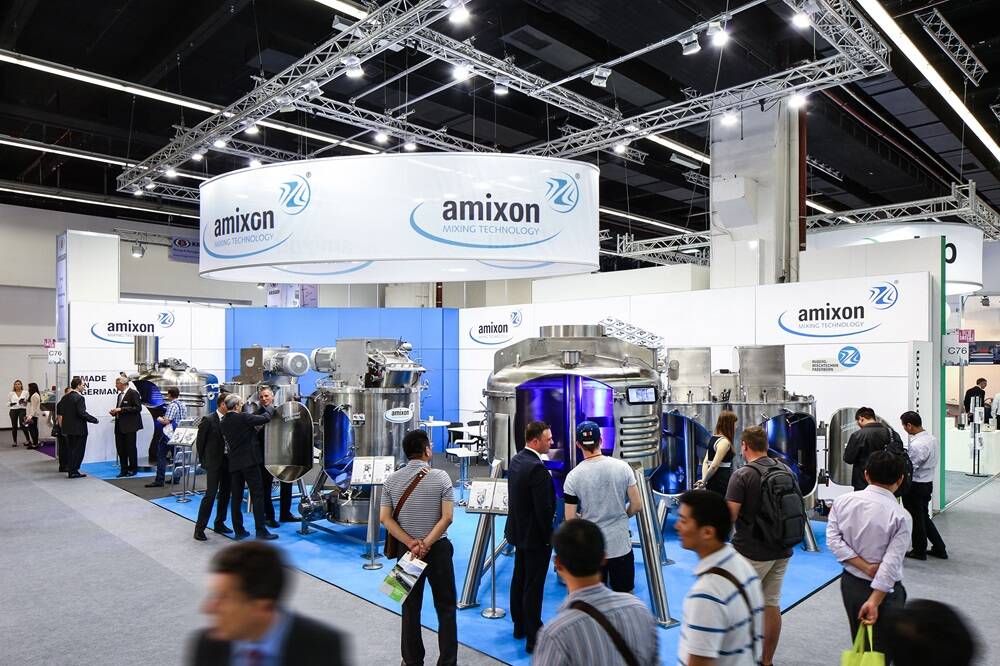
The mixing systems described above can be tested in the amixon GmbH technical center. Here, we gain interesting insights together with our customers. amixon® permanently keeps more than 30 test apparatuses available for you. In this way, we can make almost ”the entire world of powder mixing” available to our customers at one location. A day in the amixon® technical center will be rewarding for a profitable investment decision. A powder mixer usually has a long service life. Often more than 20 years, sometimes even 40 years. Many times a day, important questions repeat themselves in the daily routine:
- Preservation of particle structures: How efficiently is mixing carried out?
- Flexibility: How much may filling levels vary?
- Efficiency: How well does self-cleaning and residual emptying work?
- Production reliability: Is it enough to take a look inside the mixer?
- Acceptance and ergonomics: How quickly can inspection openings be opened and closed?
- Are inspection doors permanently tight?
- Exclusion of contamination: How long does dry cleaning take?
- Control of microbiology: How long does wet cleaning and drying take?
- many more questions .....
KoneSlid® mixers achieve ideal mixing qualities in a very short mixing time. The discharge process is completed in just a few seconds. We predict with high probability very good results and a high gain of knowledge.