Supplier sign in
Home
STAY INFORMED
Subscribe to our monthly newsletter.
Your email address will never be disclosed to any third party.
Read our privacy notice.


Press release
28.06.2024  |  2163x
Share this item
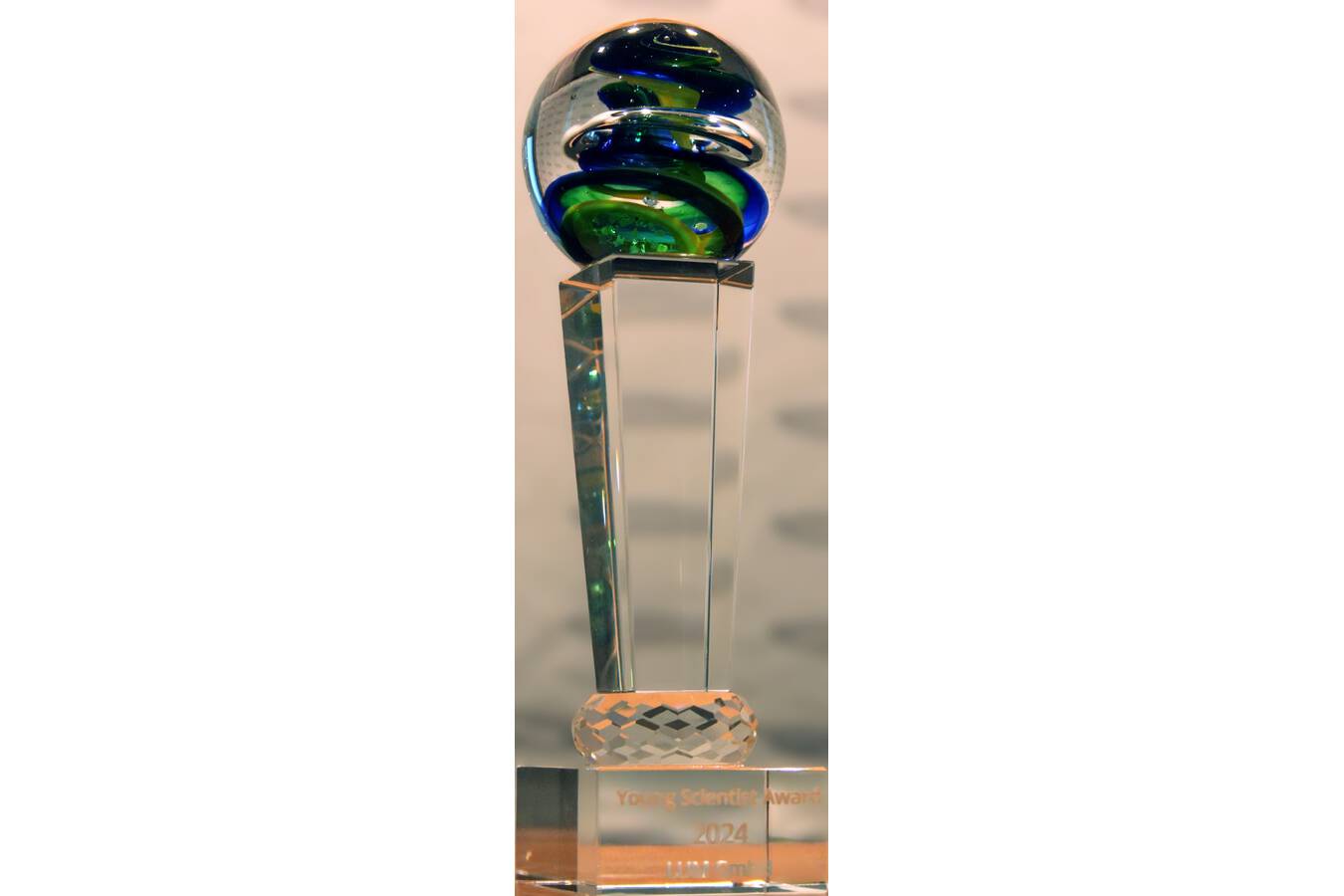
The coveted trophy for the Young Scientist 2024.

The LUM Young Scientist Award 2024 goes to Amin Said Amin

Science Prize for Amin Said Amin from the University of Duisburg-Essen

From June 10th to 11th, 2024, LUM GmbH hosted the 11th International Conference on Dispersion Analysis and Materials Testing. 70 participants from 14 countries around the world took part. Three candidates from France, India and Germany were nominated from global applications for the Young Scientist Award 2024, their work was under the motto: Particle surface properties and their understanding [1]. The finalists presented their research results to the audience and jury at the conference.

Théo Merland, Institute for Molecules and Materials of Le Mans, Le Mans University, and Soft Matter Sciences and Engineering, ESPCI Paris-Sorbonne University, France, discussed his work on aqueous fullerene suspensions. Buckminster fullerene (C60) is an attractive molecule due to its high conjugation, with applications in (electro)-optical and biomedical fields. The two different processes developed by Merland and his team to disperse large amounts of fullerene in water attracted great interest.
Priyabrata Sahoo, Centre for Nano and Soft Matter Sciences, Bengaluru, and Manipal Academy of Higher Education, Manipal, India, was nominated for his scientific achievements under the theme Interfacial Properties Dominate over Bulk Solvent Properties in Liquid Phase Exfoliation: an Experimental Study using Dispersion Analyser are summarized. Thanks to Sahoo and his team, there is now new insight into the role of the solute-solvent interface in LPE of 2D materials and dispersion stabilization. These topics that are of great interdisciplinary interest, as the intensive discussion showed.
.

M. Sc. Amin Said Amin was awarded Young Scientist 2024 for his work Developing a Methodology for Systematic Selection of Probe Liquids to Determine Hansen Solubility Parameters for Carbon Black materials [2], which he carried out at the Institute for Energy and Materials Processes – Particle Science and Technology (EMPI- PST), University of Duisburg-Essen, in Duisburg.

Hansen solubility parameters (HSP or Hansen dispersibility parameters, HDP) are used when it comes to the dispersion of particles in liquids; they characterize the surface properties of nanoparticles. HDPs can provide an understanding of key factors in the development and design of electrodes, electrolytes and other key components of electrochemical systems. Current methods for determining HDP of nanoparticles by sedimentation are based on the time-consuming use of a variety of liquids, some of which are environmentally harmful, with different HSPs.
In response to this challenge, Amin and his team developed a two-stage strategy that allows for a systematic selection of fewer liquids. The analytical multi-sample centrifuge LUMiSizer® was used for these investigations.
The process implemented by Amin and his team led to a reduction in the volume of liquid required for experiments from the current over ten to a maximum of seven. This selection was determined by a clearly defined, coherent methodology. Despite the reduction in the probe fluid list, the HSP values for carbon black did not change significantly.
In addition to carbon black, the validation process included other diverse materials such as nanoscale non-pigmented titanium dioxide, silicon/carbon composites and lanthanum cobaltite particles. These materials are widely used in applications such as fuel cells, batteries, cyclohexene oxidation, catalytic combustion, photocatalysis, and heterogeneous Fenton reactions.

As laudator Prof. Dr. Dr. Lerche, chairman of the scientific conference, emphasized in his speech that the work of Amin Said Amin is a worthy follow-up to the seven previous prize winners from Israel (2014), the Netherlands (2015), Australia (2016) and Germany. 2016, 2018, 2019) and Brazil (2022). The new experimental approach makes it possible to demonstrate the potential of analytical centrifugation for particle surface characterization, to apply it successfully and to enormously reduce or even completely avoid environmentally harmful influences and potential health risks. The award winner’s results have already been published internationally in ChemCatChem [3].
Prof. Lerche was very pleased to introduce the new external jury members for the upcoming LUM Awards to the conference audience. Prof. Dr.-Ing. Doris Segets, University of Duisburg-Essen, Nanoenergy Technology Center (NETZ), Chair for Particle Science and Technology, Institute for Energy and Materials Processes; PD Dr.-Ing. habil. Frank Babick, Technical University of Dresden, Institute for Process Engineering and Environmental Technology, Head of Research Group Mechanical Process Engineering, Privatdozent at the Faculty of Mechanical Science and Engineering; and Dr.-Ing. Johannes Walter, Friedrich Alexander University Erlangen-Nuremberg, Chair for Solid and Interface Process Engineering, Head of Research Group Advanced Colloid Characterization.

References

  1. Press release LUM GmbH of 15 April 2024
  2. Developing a Methodology for Systematic Selection of Probe Liquids to Determine Hansen Solubility Parameters for Carbon Black materials, Amin Said Amin et al., International Conference Dispersion Analysis & Materials Testing 2024, Abstracts,
  3. A Procedure for Rational Probe Liquids Selection to Determine Hansen Solubility Parameters, Amin Said Amin et al., 16. January 2024.


Company information

More items

Testing the adhesive strength of cathode & anode coatings Application of the LUMiFrac® for testing the adhesive strength of cathode & anode coatings in lithium-ion batteries
Testing the adhesive strength of cathode & anode coatings
Application of the LUMiFrac® for testing the adhesive strength of cathode & anode coatings in lithium-ion batteries In a lithium-ion battery, the smallest unit of each cell consists of two electrodes (anode and cathode), and the separator. The ion-conducting electrolyte is located in between. Typically, the main component of the anode is graphite, which is excellent for storing lithium ions during charging. However, graphite’s limited electrical conductivity can cause inefficiencies in charge and discharge cycles. To boost the anode’s performance, the coating system is applied to a thin copper foil. The copper foil enhances electrical conductivity which facilitates the electron flow between the anode and the rest of the battery, including the cathode. As a result, the battery’s internal resistance decreases, leading to more efficient charging and discharging processes. This translates to higher power output and better overall performance. The coating system prevents corrosion of the copper foil, ensures stability, and maintains electrolyte compatibility. The active material
17.05.2024  |  2726x  |  Product news  | 
Particle surface properties and their understanding - a trend ...also among young scientists.
Three candidates from Europe and India nominated for the LUM Science Prize YSA in June 2024. Get in touch with the finalists at the conference; you are cordially invited to Berlin.
Particle surface properties and their understanding - a trend
...also among young scientists. Three candidates from Europe and India nominated for the LUM Science Prize YSA in June 2024. Get in touch with the finalists at the conference; you are cordially invited to Berlin. On June 10th and 11th, 2024, LUM GmbH will be hosting the 11th International Conference on Dispersion Analysis and Material Testing (ICDAMT 2024) in Berlin. Prof. Dr. Dr. Lerche, Chairman of the Scientific Committee and LUM Managing Director: “Since 2014, we have been advertising the Young Scientist Award (YSA) for outstanding scientific achievements in the areas of particle and dispersion characterization as well as materials testing and awarding it at the conference according to defined quality criteria. Young scientists from Germany, France, India, Norway and the Czech Republic answered the call and applied for the prize. Three finalists from Europe and India were ultimately nominated by the jury for 2024. They are expected to attend the conference with their interesting results upon invitation. Completely independent of the selection procedure, the overarching theme of particle surface properties and their characterization is excitingly visible in all nominated
15.04.2024  |  2624x  |  Press release  | 
An important tool in quantum dot research Analytical centrifugation is also an important tool in quantum dot research
An important tool in quantum dot research
Analytical centrifugation is also an important tool in quantum dot research Moungi G. Bawendi, Louis E. Brus and Alexei I. Ekimov are awarded the Nobel Prize in Chemistry 2023 for the discovery and development of quantum dots. These tiny particles have unique properties and now spread their light from television screens and LED lamps. They catalyse chemical reactions and their clear light can illuminate tumour tissue for a surgeon.[1] LUM GmbH cordially congratulates this year’s award winners. Since 1998, users in research and industry have been using the innovative analysis devices, made by LUM GmbH, for comprehensive particle and dispersion characterization, for determining joint and layer strengths and for recording product and process parameters. In the laboratory, at-line and, more recently, in-line. The analytical centrifuges from the LUMiSizer product line are also used in research on quantum dots and their applications. Zhongliang Hu et al. reported the use of carbon quantum dots (CQDs) as nanoparticle tracers and sensors for
11.10.2023  |  2468x  |  Press release  | 
Young Scientist 2022 - Lia Beraldo da Silveira Balestrin Young Scientist 2022 - Lia Beraldo da Silveira Balestrin with the topic:
LUMiSizer: an important tool in asphaltene inhibition studies
Young Scientist 2022 - Lia Beraldo da Silveira Balestrin
Young Scientist 2022 - Lia Beraldo da Silveira Balestrin with the topic: LUMiSizer: an important tool in asphaltene inhibition studies From January 24th to 25th, 2022, LUM GmbH hosted the 10th International Conference for Dispersion Analysis and Materials Testing. 90 participants from 24 countries around the world took part. Five candidates from South America and Europe were nominated for the Young Scientist Award 2022, their work was themed: learn from nature, use resources more effectively and avoid harmful effects [1]. Two Brazilian and two German participants faced the final selection process and discussed their research results with the audience and jury at the virtual conference. Dr. Lia Beraldo da Silveira Balestrin was elected Young Scientist 2022 for her work: ”LUMiSizer: an important tool in asphaltene inhibition studies” [ref 2], which she carried out at the Department of Chemistry, Campinas University in Brazil. Balestrin’s work aimed to study the colloidal behaviour of asphaltenes as a function of time and their structure under different compositional conditions. This involved
14.02.2022  |  4451x  |  Press release  | 
PORTALS
BulkSolids-Portal Schuettgut-Portal Recycling-Portal
Related
Bulkgids.nl
SIGN UP FOR OUR NEWSLETTER
Newsletter archive
Service and contact
ContactDisclaimerPrivacyAdvertising
FOLLOW US
Linked