Supplier sign in
Home
STAY INFORMED
Subscribe to our monthly newsletter.
Your email address will never be disclosed to any third party.
Read our privacy notice.
EVENT
09-11-2026 – 12-11-2026
Share:
Type:Professional CourseDuration:4 daysStarts:09-11-2026Ends:12-11-2026Place:HamburgEntry:paid
More information

Professional Course Fluidization Technology

Professional Course

Course Overview

Hybrid (on-site in Hamburg and online)
This professional course focuses on fluidization technology, crucial in process engineering for particle formulation, classification, drying, adsorption, heating and cooling of solids, combustion, pyrolysis, carbonization, gasification, calcination or gas-solid reactions within fluidized beds. It covers a wide range of applications from food and fine chemicals to biotechnological and pharmaceutical industries, producing dust-free, free-flowing particles with improved properties.

Key Learning Areas

Participants will explore the fundamentals and applications of various types and different scales of fluidized bed processes for drying, coating, granulation and agglomeration of particles with practical hints and extensive calculation examples. The focus is on fluid mechanics, mixing, heat and mass transfer and particle formulation mechanisms. The curriculum integrates practical hints, calculation examples, actual industrial applications, modern computational tools, and measuring techniques.

Practical Sessions & Expert Insights

The course incorporates hands-on trainings, demonstrations, and tutorials to enhance the learning experience. Experts from the industry will share insights on procedures and approaches used in plant construction, optimization, and process operation across chemical, food, and pharmaceutical sectors, alongside novel measuring techniques.

Target Audience

Designed for engineers, chemists, and food/pharmaceutical technologists, this course provides a deep understanding of modern and efficient fluidized bed processes. The course language is English.

Course Content

  • Introduction to fluid-mechanical principles
  • Local fluid mechanics
  • Methods for the characterization of fluidized beds
  • Heat transfer in fluidized beds
  • Mass transfer in fluidized beds
  • Fundamentals of granulation and agglomeration
  • Fluidized bed spray granulation
  • Flowsheet simulation of complex solids processes
  • Hands-on trainings and demonstrations

Speakers

  • Prof. Stefan Heinrich, Hamburg University of Technology
  • Dr.-Ing. Swantje Pietsch-Braune, Hamburg University of Technology
  • Dr.-Ing. Vasyl Skorych, DyssolTEC, Hamburg University of Technology
  • Prof. Evangelos Tsotsas, Otto von Guericke University Magdeburg
  • Prof. Sankaran Sundaresan, Princeton University (USA)
  • Prof. Mirko Peglow, Pergande Group, Weißandt-Gölzau, Germany
  • Dr.-Ing. Lennard Fries, Nestlé Purina North America, St. Louis
  • Dr.-Ing. Michael Jacob, Glatt Ingenieurtechnik GmbH, Weimar, Germany
  • Dr.-Ing. Sören Lehmann, Glatt Pharmaceutical Service GmbH & Co. KG, Binzen, Germany
  • Prof. Frank Kleine Jäger, BASF SE, Ludwigshafen, Germany
  • Dr.-Ing. Paul Kieckhefen, Helmholtz AI, Karlsruhe, Germany

Date:

Start: Monday, November 9th, 2026, 11:00 a.m.
End: Thursday, November 12th, 2026, 3:00 p.m.

Information for online participants:

The online version of the course will be transferred via the conference tool Zoom. The access data (link, personal password) to the webinar will be sent to you by email in good time before the start of the course.


Related events

Webinar TTC webinar "Particle and Process Design across Industries"
Particle and Process Design across Industries Particle engineering focuses on designing particle properties to achieve targeted product performance. This webinar gives a short introduction to key technologies such as spray drying, granulation, coating, and particle functionalization. Through short expert overviews, participants gain first insights into selecting the right technology for product development. The session concludes with an open Q&A. What do you learn? * When to apply agglomeration, spray granulation, or coating, and the strengths and limitations of batch and continuous processing * How process selection influences final product performance * How coating technologies modify particle functionality and how process conditions affect coating quality, particle structure, and functional properties * How industrial examples illustrate the transfer of particle engineering technologies across different industries Who should attend? This webinar is designed for professionals in product and process development, innovation, engineering, and R&D who work with particulate products in food, fine chemicals, pharmaceuticals, advanced materials, battery materials, and specialty chemicals. Speakers * Stephan Rüscher, Technology Training Center * Dr. Michael Jacob, Glatt Ingenieurtechnik Weimar * Prof. Dr.-Ing. habil. Evangelos Tsotsas, Otto von Guericke University Magdeburg * Moderation: Markus Köbel Want to go deeper? Join our three-day hands-on workshop (TTC 272, December 1-3, 2026) at Glatt's pilot plant in Weimar.
09.11.2026 | Webinar | An afternoon | Online | Entry: Free (after registration)
Workshop Particle and Process Design Across Industries
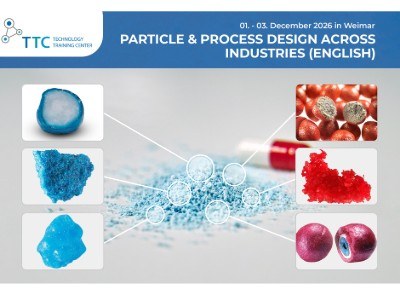
Particle and Process Design Workshop This workshop, organized by the TTC Technology Training Center, focuses on particle engineering to achieve targeted product performance. It covers key technologies such as spray drying, spray granulation, agglomeration, coating, and particle functionalisation, explaining their influence on particle structure and functionality. Learning Experience Participants will gain practical insights through expert lectures, case studies, and demonstrations at Glatt's pilot facilities in Weimar, Germany. The event offers a unique opportunity to compare a broad range of particle engineering technologies. Who Should Attend? The workshop is designed for professionals in product and process development, innovation, engineering, and R&D. It is relevant for those working with particulate products in pharmaceuticals, food, fine chemicals, advanced materials, battery materials, and specialty chemicals. Event Details The event takes place from December 1-3, 2026, in Weimar, Germany. The participation fee is €2,250 (excluding VAT). This fee includes participation, accompanying course notes, daytime catering, and dinner. A certificate of attendance will be provided. Registration deadline is November 20, 2026.
01.12.2026 – 03.12.2026 | Workshop | 3 days | Weimar | Entry: paid

Event organizer

Glatt Ingenieurtechnik GmbH
Glatt is specialized in intelligent particle design for the generation and functionalization of powders and granulates with defined, adjustable properties. The focus is on particles and powders for pigments, catalytic, ceramic or battery materials as well as for granules and pellets as additives for e.g. industrial salts, detergents and cleaning agents, fertilizers, pesticides, food, feed, dietary supplements and pharmaceuticals. Encapsulation of flavors, enzymes, vitamins, microorganisms, probiotics or fatty acids (PUFA) is just as possible as encapsulation of essential oils and other active, sensitive substances to be protected. With Glatt Powder Synthesis, a unique technology for spray calcination, it is possible to generate, coat and then calcine particles in a pulsing hot gas stream in a single process step. As a pioneer in fluid bed and spouted bed technologies, Glatt masters these important processes for the formulation and optimization of particle properties through defined spray agglomeration, spray granulation, spray coating or (micro)encapsulation as well as through combinations of these processes. Also in the high temperature range. Glatt supports the product idea from the early phase of product formulation through process development to scale-up to production scale. Under the leadership of the Glatt Process & Plant Engineering teams, customized production plants for nutrition, fine chemicals, pharmaceuticals, and biotech applications are successfully planned and commissioned. Worldwide. Whether based on powder synthesis, fluid bed or spouted bed technology, Glatt also offers certified contract manufacturing for customers without their own production capacities.
Last update: 17-08-2026

Related posts

Encapsulation of sensitive, active or volatile substances in a matrix Micro-encapsulation: Encapsulation from the liquid. Combination of drying, granulation and release control in one step. Protection of sensitive ingredients. Safe embedding of volatile substances.
Encapsulation of sensitive, active or volatile substances in a matrix
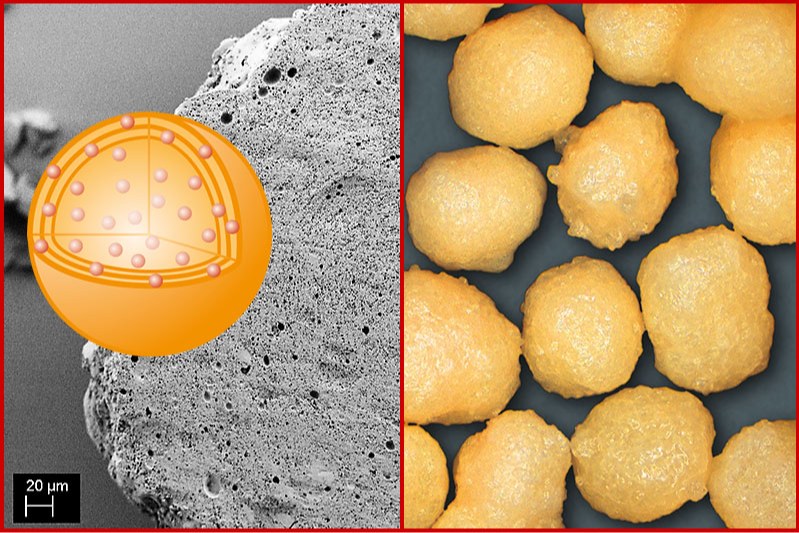
Micro-encapsulation: Encapsulation from the liquid. Combination of drying, granulation and release control in one step. Protection of sensitive ingredients. Safe embedding of volatile substances. Microcapsules in solid matrix for perfect enclosure and protection of sensitive substances Valuable substances that require special protection are often present in powder or even liquid form. This encapsulation process is used in particular for products and ingredients for the food industry. These include probiotics or essential oils, fragrances and flavors, for example. Micro-encapsulation in the fluid bed or spouted bed allows these substances to be embedded in matrix pellets, thus combining drying, granule formation and release control in a single step. The substances to be protected are emulsified and then gently granulated on the basis of spray granulation and thereby embedded homogeneously distributed in a compact protective matrix. In the field of micro-encapsulation, Glatt has conducted various case studies on formulation and process optimization strategies based on encapsulation efficiency. Depending on the preferred principle, based on the properties of the…
24-08-2026  |  1392  |  product description  | 
Continue reading
Homogenize Powder Mixtures Dust-free, free-flowing granules due to agglomeration of the powder particles. No segregation during subsequent processes, transport and storage.
Homogenize Powder Mixtures
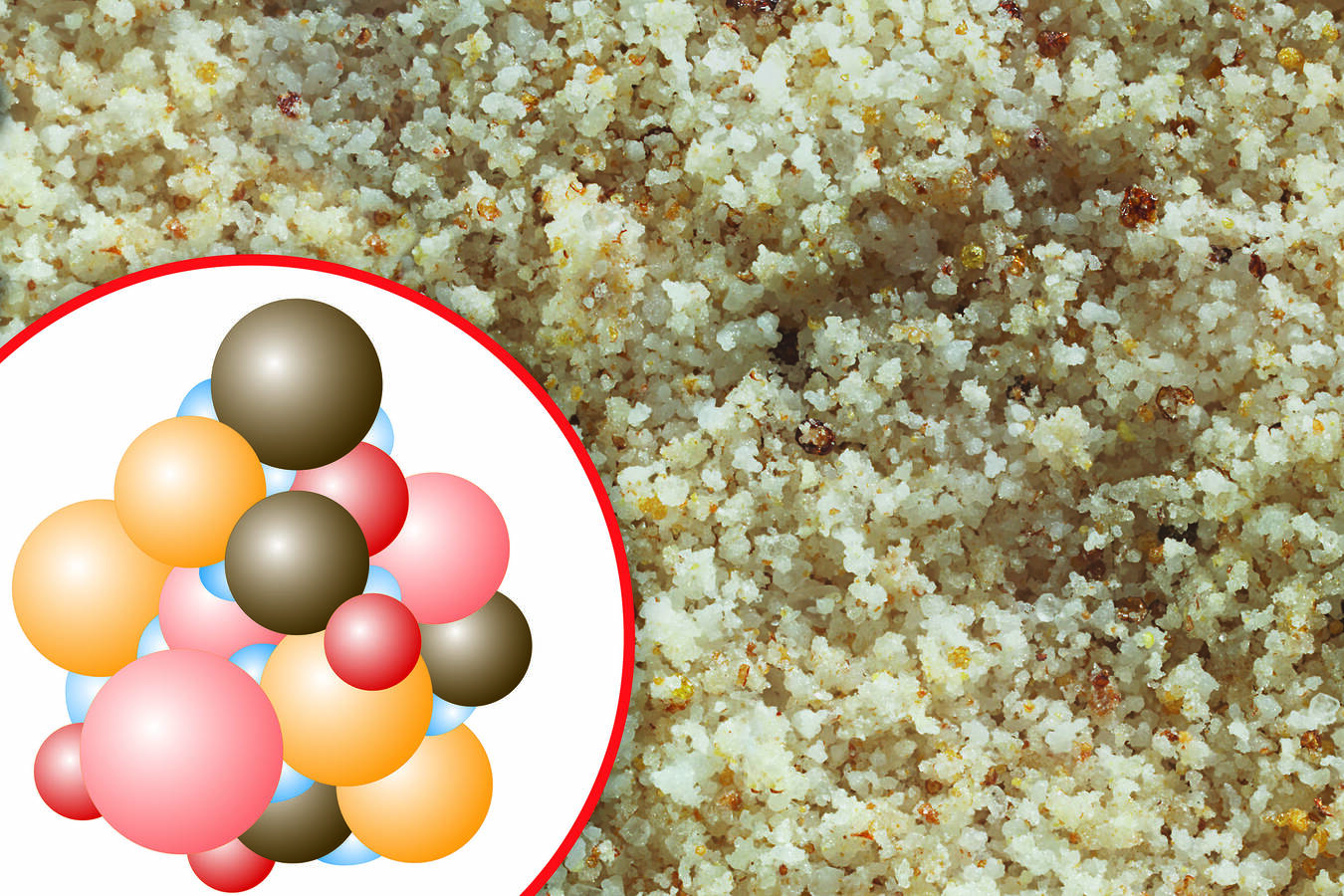
Dust-free, free-flowing granules due to agglomeration of the powder particles. No segregation during subsequent processes, transport and storage. Homogeneous product mixtures through agglomeration of the powder particles Product blends make handling easier for the user. Whether it is instant soups, powdered beverages or the homogeneous distribution of active ingredients in a carrier, the precise weighing of the components in different quantities and the mixing process can be realized much more easily in large-scale plants. But what if the starting materials are very different in terms of density, particle size and shape? Here, spray agglomeration of powders in the fluid bed of the mixture can counteract segregation in subsequent processes, packaging or transport. By spraying on a binder solution, the surface of the mixture is wetted and fine particles agglomerate into larger granules or are adhered to coarser particles. However, if the shape and size are too different, fine particles can alternatively be sprayed on together with the binder solution and thus be homogeneously distributed over the coarser components.…
03-08-2026  |  1487  |  product description  | 
Continue reading
Stabilization of Vitamins Protective coating or layering in the fluid bed for maximum effect with reduced material input
Stabilization of Vitamins
Protective coating or layering in the fluid bed for maximum effect with reduced material input Increased transport and storage stability: - Reduced sensitivity to light. - More resistance to oxygen, moisture and higher temperatures. Vitamins are essential substances and must be regularly supplied to the organism. A distinction is made between hydrophobic and hydrophilic substances. While fat-soluble vitamins are accumulated in the body, excess water-soluble substances are excreted. Due to their reactivity, vitamins are very sensitive to oxidation, light and moisture. Enriched products therefore usually contain increased vitamin levels to compensate for degradation during storage. Processes such as microencapsulation, layering of active ingredients onto carriers, or coating with protective polymers can increase stability and thus reduce the amount of vitamin needed. A typical example is sustained-release vitamin C or folic acid pellets with a protective coating. With layering on carriers, vitamin contents but also trace elements can be precisely dosed. There…
03-07-2026  |  1933  |  product description  | 
Continue reading
Increasing the Bioavailability of Active Ingredients Enhanced efficacy of coenzyme Q10, curcuma or similar ingredients
Increasing the Bioavailability of Active Ingredients
Enhanced efficacy of coenzyme Q10, curcuma or similar ingredients To enable the body to absorb essential nutrients While this issue is the most essential for the formulation of pharmaceutical dosage forms, as it determines the efficacy of the drug, studies on the uptake of dietary supplements are only just beginning. However, water-insoluble substances cannot be absorbed by the body and must therefore be converted into a soluble micellar structure. In liquid form, these formulations have a limited shelflife stability, so a drying step follows, which produces a wide variety of product forms ranging from readily mixable powders to dust-free, easily soluble granules or compact, defined pellets. The moderate and precisely controllable process temperature in the fluidized bed or spouted bed is particularly suitable for sensitive active ingredients. Coenzyme Q10, curcuma or similar substances are typical candidates for improving bioavailability. The process steps required for this can be completely tested from micelle formation to…
21-05-2026  |  2152  |  product description  | 
Continue reading
Fine-tuning product parameters for instant products Fast solubility. Low bulk density. Good flowability. Good dosability.
Fine-tuning product parameters for instant products
Fast solubility. Low bulk density. Good flowability. Good dosability. Transform your powders into porous, dust-free, easy-flowing and homogeneous granules by means of Glatt fluid bed spray agglomeration. Fluid bed spray agglomeration of fine powders enables the production of porous granules with a defined particle specification. Due to the relatively low mechanical forces during agglomeration in the fluid bed, agglomerates with a capillary structure, porous surfaces and only a low dust content are produced. These are the best prerequisites for good wettability. These products therefore have excellent dispersibility and are soluble in water. They have a low bulk density and their particle size distribution – usually between 0.2 and 2.5 mm – can also be controlled. The interconnected powder particles are homogeneously distributed and improve flowability and reduce electrostatic charging. A wide range of effects can be achieved via the choice of spray medium, its composition and concentration. Simply changing the viscosity of the…
27-04-2026  |  2112  |  product description  | 
Continue reading

Related articles

PORTALS
✓ BulkSolids-Portal Schuettgut-Portal Recycling-Portal
Related
Bulkgids.nl
SIGN UP FOR OUR NEWSLETTER
Newsletter archive
Service and contact
About, ContactDisclaimerPrivacyAdvertisingControl panel login
Follow us
Linked
Supplier sign in