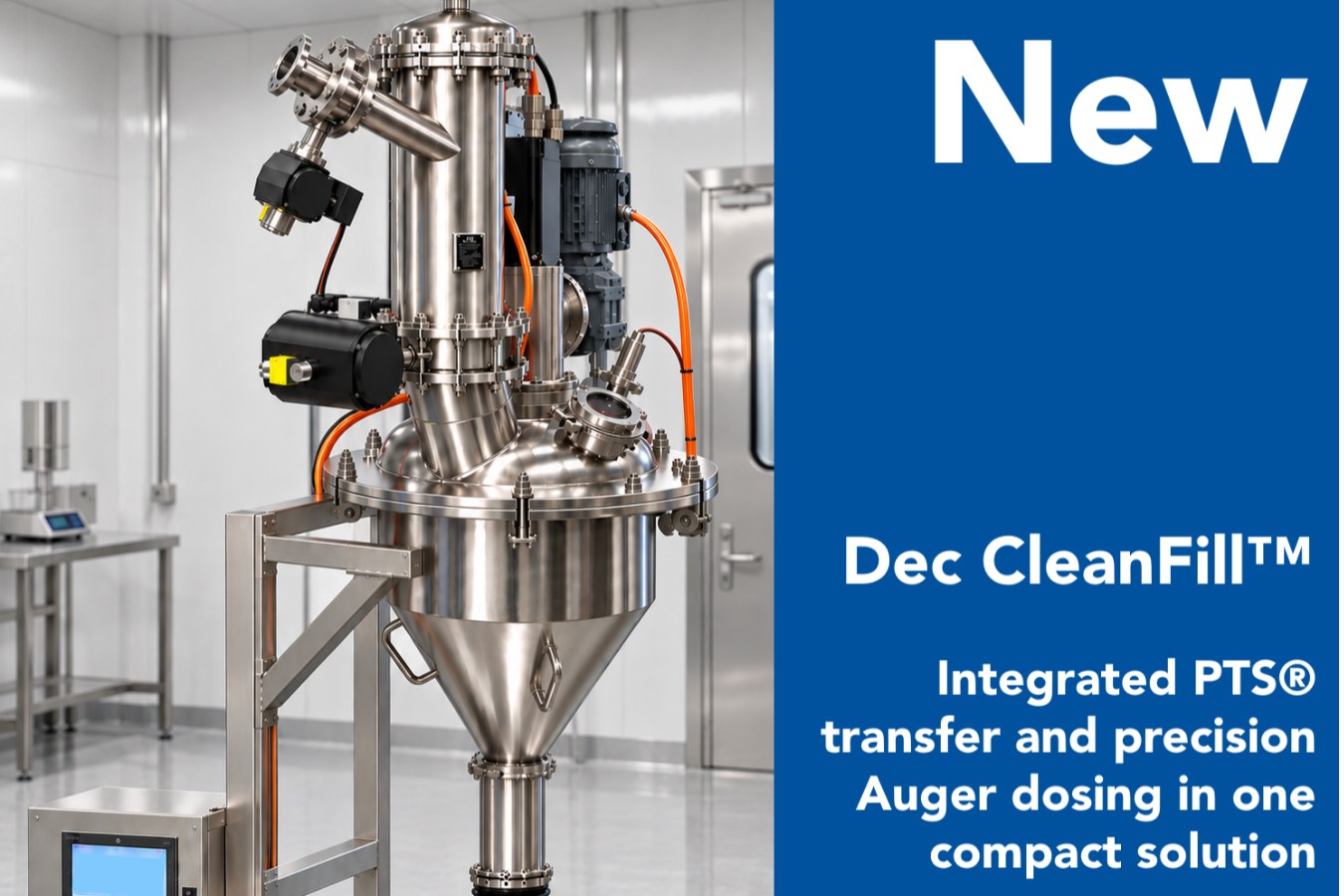
Dec Group Introduces the New Dec CleanFill™ at Powtech Technopharm
Designed for the Needs of Modern Manufacturing Environments
Production facilities require flexible technologies that can adapt to changing products, batch sizes, and regulatory requirements. Dec CleanFill™ has been designed with these challenges in mind. At Powtech Technopharm, Dec Group will unveil Dec CleanFill™, an innovative dosing solution designed to address the increasing demands of modern pharmaceutical, chemical, and food manufacturing. Developed with a strong focus on accuracy, containment, and ease of operation, Dec CleanFill™ brings together proven technologies in a compact and highly efficient system. As manufacturers continue to seek safer and more efficient ways to handle powders, the need for reliable dosing systems has never been greater. Dec CleanFill™ answers this challenge by integrating advanced powder transfer and dosing technologies into a single solution that optimizes performance while supporting stringent quality and safety requirements. Engineered for Performance At the heart of Dec CleanFill™ is the combination of: * PTS Powder Transfer System® technology for safe and contained powder feeding * Servo-driven auger dosing delivering fast, accurate, and repeatable results * Optional…