Supplier sign in
Home
STAY INFORMED
Subscribe to our monthly newsletter.
Your email address will never be disclosed to any third party.
Read our privacy notice.
Specialist article
23-08-2026  |  2164 x
Share:

Technical Methods for Industrial Silo Cleaning and Unblocking

Industrial silo cleaning combines process engineering, safety, and inspection. Specialized techniques range from vacuum suction and rope access to controlled explosive unblocking.

Causes of Flow Obstructions in Bulk Storage Silos

Bulk solids exhibit complex behavior influenced by particle size, moisture, and wall friction. These properties can lead to caking, rat-holing, or bridging above the discharge. Simply activating discharge aids often fails to solve the blockage, requiring a systematic assessment of the causes.

Methods for Silo Cleaning and Unblocking

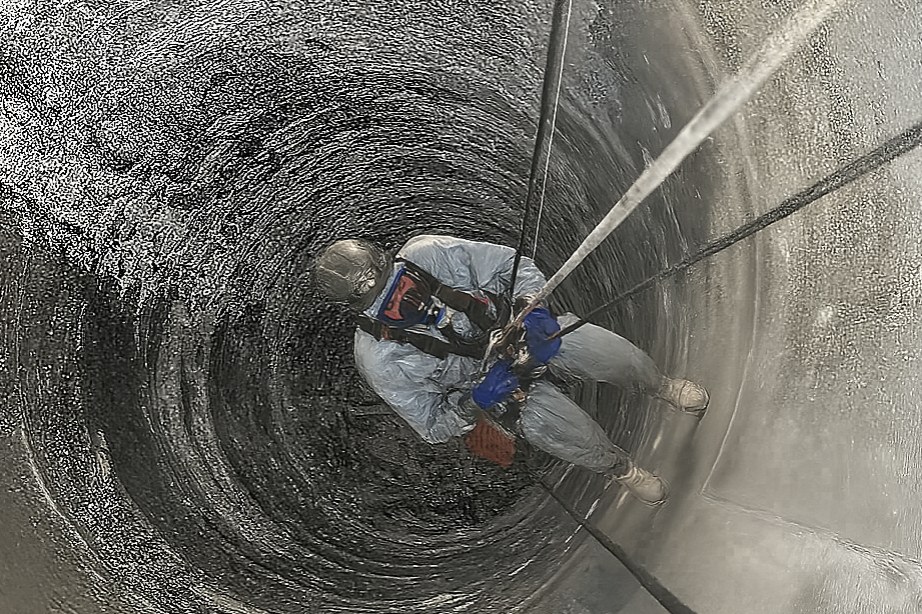
Various specialized procedures are applied depending on material hardness and vessel geometry. High-capacity vacuum suction units safely extract loose bulk materials. For heavily compacted mineral deposits such as cement or clinker, techniques like high-pressure water blasting, abrasive blasting, or controlled explosive cleaning are utilized.

Occupational Safety and Access Techniques

Working inside silos involves confined space entry and strict safety regulations. Rope access techniques executed by certified technicians allow efficient reach to internal surfaces without scaffolding. Comprehensive explosion protection (ATEX) and emergency rescue plans are critical during maintenance operations.

Inspection as Part of Preventive Maintenance

Emptying and cleaning bulk storage units creates ideal conditions for visual and technical inspection. Video documentation and non-destructive testing, such as ultrasonic wall thickness measurement, help detect corrosion, cracking, and structural wear before severe damage occurs.


Company information

Related articles

PFAS in Fire Protection Systems Technical Assessment, Operator Responsibility and Economic Decision Risks in Existing Installations
PFAS in Fire Protection Systems
Technical Assessment, Operator Responsibility and Economic Decision Risks in Existing Installations The discussion surrounding PFAS-contaminated fire protection systems has evolved rapidly from a niche issue into a critical operational and regulatory challenge for facility operators. What stands out is not only the technical complexity of the subject, but the increasing divergence in recommendations provided by different stakeholders. While some market participants advocate for complete system replacement as a default solution, operators are left questioning whether such measures are technically justified or primarily driven by economic incentives. At its core, PFAS contamination differs fundamentally from conventional contamination scenarios. It is not a localized issue that can be easily isolated and removed. Instead, PFAS compounds tend to distribute throughout the system, often in trace concentrations, while precursor substances may remain undetected in standard analytical approaches. This creates a situation where simplified solutions are frequently presented,…
16-04-2026  |  6425  |  specialist article  | 
Continue reading
Efficient Restoration of Discharge Functions Using Controlled Impulse  Blasting technology enables the targeted removal of bulk material blockages in silos and discharge systems using controlled impulse energy. Following material suitability testing and expert evaluation, even severe consolidations can be reso
Efficient Restoration of Discharge Functions Using Controlled Impulse
Blasting technology enables the targeted removal of bulk material blockages in silos and discharge systems using controlled impulse energy. Following material suitability testing and expert evaluation, even severe consolidations can be reso In the bulk solids industry, discharge blockages are among the most critical operational disturbances. Consolidated materials, bridging effects, or compaction in the cone section often cause silos and bunkers to completely lose their discharge capability. Plants in the cement, lime, gypsum, chemical, and building materials industries are particularly affected, especially where hygroscopic or reactive materials are stored. Conventional blockage removal methods are usually time-consuming and associated with significant risks. Mechanical breaking, high-pressure water cleaning, or manual intervention inside silos regularly result in extended downtime, high personnel requirements, and considerable safety challenges. In many cases, success remains limited because only parts of the consolidation are removed while the structural blockage persists. In this context, blasting-based blockage removal represents a highly specialized method in which consolidated material structures…
11-04-2026  |  5039  |  specialist article  | 
Continue reading
Tank- und Siloreinigung: Wie? Warum? Weshalb?
This item is only available in German
06-03-2021  |  7491  |  specialist article  | 
Continue reading

Related posts

PORTALS
✓ BulkSolids-Portal Schuettgut-Portal Recycling-Portal
Related
Bulkgids.nl
SIGN UP FOR OUR NEWSLETTER
Newsletter archive
Service and contact
About, ContactDisclaimerPrivacyAdvertisingControl panel login
Follow us
Linked
Supplier sign in