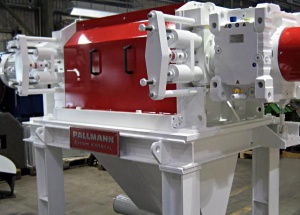
Pallmann PDWM Karakal for recycling rubber waste back into fine powders
Zweibrücken, Germany (16 October 2013) – A new grinding system from Pallmann enables energy-efficient recycling of vulcanized rubber waste back into fine powder for direct reuse in rubber processing. A key feature of the Karakal is its ability to devulcanize the rubber as it pulverizes it, so that it can be used in place of virgin material.
Karakal is a type of twin-roll mill that has been designed specifically for recycling waste from production of technical parts, as well as waste arising from retreading truck tyres. It accepts material that has been pre-cut to a particle size of 4 mm or less, and which is fed to it continuously by a series of screws positioned along the gap between the rollers. Pallmann has applied for several patents on technology incorporated into the equipment.
“There is quite a lot of waste produced in the rubber processing sector, and we wanted to develop a cost-effective process that would enable it to be recycled back into production,” says Mr. Rolf Gren, Senior Executive VP PALLMANN Group. “For this, you need to down-size the material into a very fine powder, with particle sizes of under 500 micron and a D50 [median diameter] of around 250 micron—so, really fine powders.”
In the past, cryogenics have been used for producing powder from rubber waste, but this creates particles with cubic geometries, which Gren says are not best suited for incorporation into new compounds. More recently, conventional roller mills have been used, but these create particles of around 800 to 1000 micron, which is too big for reprocessing operations. This process is also very energy-intensive. “
What you want is smaller particles, with a rough surface,” says Gren. “With the Karakal, that is what you get, and it is also a much lower energy consumer.”
The temperature at which the process runs is also controllable. According to Gren, at the high temperatures achievable in the Karakal process, some devulcanization occurs. “This is fantastic for the industry, because it means that processors can take the powder and add it straight back into the original mixer in place of virgin rubber.” Process air is used to cool the powder after it has been ground.