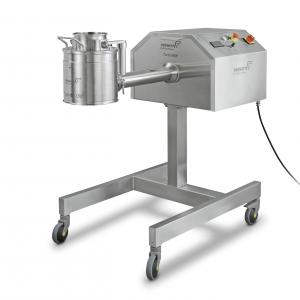
Deagglomeration
Gentle deagglomeration of bulk goods
Frewitt has developed a deagglomeration system that is designed to improve the quality of the final product when processing solids. The TurboWitt uses a rotary sieve drum, in which agglomerates are broken up by gentle acceleration and shearing forces. The result: Improvement of the flow properties in the processing powders, more precise metering, faster product conveying, and greater production output. All of these advantages lead to substantial improvements in downstream processes as well. To prevent the formation of bridges, two fixedly mounted stator arms convey the product through the sieve openings. According to the manufacturer, users of a ConiWitt can quickly and easily convert the system into a TurboWitt.
Diversity in laboratory use
The HammerWitt-Lab is ideal for processing hard, crystalline, or fibrous products in the laboratory or in the production of small batches. As it enters the milling chamber, the milling product hits the hammer side of the rotor and the wall of the milling chamber. The double milling effect is one of the main reasons why the milling process is so efficient. The semi-detached mounting of the drive unit prevents the product from being heated up by the machine during the milling process, an important feature for manufacturing solid formulations of drugs. Another characteristic of the hammer mill is the increased rotor speed, which results in a high flow rate and a uniform grain size distribution. Crystalline and hard products can be milled with the hammer side of the rotor, whereas fibrous products are milled with the cutting side. The hammer mill is easy to clean, and the FDA compliant seals prevent cross contamination.